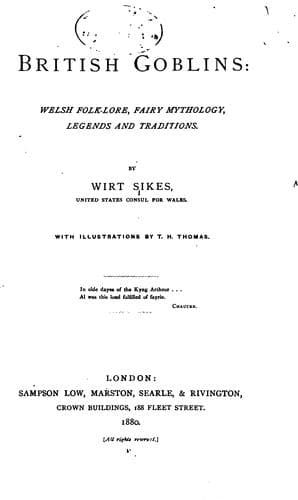
British Goblins: Welsh Folk-lore, Fairy Mythology, Legends and TraditionsSikes, Wirt
History
British Goblins: Welsh Folk-lore, Fairy Mythology, Legends and Traditions
Sikes, Wirt
Folklore -- Wales; Goblins -- Wales; Mythology, Celtic -- Wales; Mythology, Welsh; Wales -- Social life and customs
It remains but to add, in connection with our household ghosts, that
the method of exorcising such goblins in Wales is explicit. The
objectionable spectre must be conjured, in the name of Heaven, to
depart, and return no more. Not always is this exorcism effective; the
ghost may have a specific purpose in hand, or it may be obstinate. The
strength of the exorcism is doubled by employing the Latin language to
deliver it; it receives its utmost power, however, through the clergy;
three clergymen, it is thought, will exorcise any ghost that walks.
The exorcism is usually for a stated period; seven years is the
favourite time; one hundred years the limit. There are many instances
where a ghost which had been laid a hundred years returned at the end
of the time to its old haunts. In all cases it is necessary the ghost
should agree to be exorcised; no power can lay it if it be possessed
of an evil demon--a spirit within a spirit, as it were--which
stubbornly refuses to listen to argument. In such cases the terrors of
Heaven must be rigorously invoked; but the result is only temporary.
Properly constituted family ghosts, however, will lend a reasonable
ear to entreaty, backed by prayer. There are even cases on record
where the ghost has been the entreater, as in the story of Haunted
Margaret.
Haunted Margaret, or Marget yr Yspryd, was a servant-girl who lived in
the parish of Panteg. She had been seduced by a man who promised to
marry her, and a day was set for their wedding; but when the day came,
the man was not on hand, and Margaret thereupon fell on her knees in
the church and prayed Heaven that her seducer might have no rest
either in this world or in the world to come. In due course the man
died, and immediately his ghost came to haunt Margaret Richard. People
heard her in the night saying to the ghost, 'What dost thou want?' or
'Be quiet, let me alone;' and hence it was that she came to be known
in that parish by the nickname of Marget yr Yspryd. One evening when
the haunted woman was at the house of Mrs. Hercules Jenkins, at
Trosdra, she began to be uneasy, and as it grew late said, 'I must go
now, or else I shall be sure to meet him on the way home.' Mrs.
Jenkins advised Margaret to speak to him; 'and tell him thou dost
forgive him,' said the good dame. Margaret went her way, and as she
drew near a stile at the end of a foot-bridge, she saw the ghost at
the stile waiting for her. When she came up to it the ghost said, 'Do
thou forgive me, and God will forgive thee. Forgive me and I shall be
at rest, and never trouble thee any more.' Margaret then forgave him,
and he shook hands with her in a friendly way, and vanished.
CHAPTER III.
Spectral Animals--The Chained Spirit--The Gwyllgi, or Dog of
Darkness--The Legend of Lisworney-Crossways--The Gwyllgi of
the Devil's Nags--The Dog of Pant y Madog--Terrors of the
Brute Creation at Phantoms--Apparitions of Natural
Objects--Phantom Ships and Phantom Islands.
I.
Public-domain text, read in full here on John Shaqi.
Reviews
Reviews
No reviews yet
Be the first to share your thoughts on this work.
Elsewhere in the archive
Join the Discussion
Join the discussion
Sign in to leave a comment or review.
Sign InorCreate an account