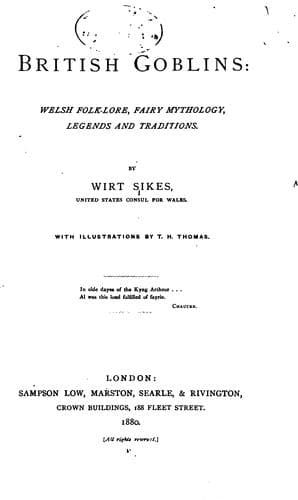
British Goblins: Welsh Folk-lore, Fairy Mythology, Legends and TraditionsSikes, Wirt
History
British Goblins: Welsh Folk-lore, Fairy Mythology, Legends and Traditions
Sikes, Wirt
Folklore -- Wales; Goblins -- Wales; Mythology, Celtic -- Wales; Mythology, Welsh; Wales -- Social life and customs
Of spectral animals there is no great diversity in Cambria, unless one
should class under this head sundry poetic creatures which more
properly belong to the domain of magic, or to fairyland. The spirits
of favourite animals which have died return occasionally to visit
their masters. Sometimes it is a horse, which is seen on a dark night
looking in at the window, its eyes preternaturally large. More often
it is the ghost of a dog which revisits the glimpses of the moon. Men
sometimes become as fondly attached to a dog as they could to any
human being, and, where the creed of piety is not too severe, the
possibility of a dog's surviving after death in a better world is
admitted. 'It is hard to look in that dog's eyes and believe,' said a
Welshman to me, 'that he has not a bit of a soul to be saved.' The
almost human companionship of the dog for man is a familiar fact. It
is not strange, therefore, that the dog should be the animal whose
spirit, in popular belief, shares the nature of man's after death.
II.
Sometimes the spirit in animal form is the spirit of a mortal, doomed
to wear this shape for some offence. This again trenches on the
ground of magic; but the ascription to the spirit-world is distinct in
modern instances. There was a Rev. Mr. Hughes, a clergyman of the
Church of England, in the isle and county of Anglesea, who was
esteemed the most popular preacher thereabout in the last century, and
upon this account was envied by the rest of the clergy, 'which
occasioned his becoming a field preacher for a time, though he was
received into the Church again.'[69] As he was going one night to
preach, he came upon an artificial circle in the ground, between
Amlwch village and St. Elian Church, where a spirit in the shape of a
large greyhound jumped against him and threw him from his horse. This
experience was repeated on a second night. The third night he went on
foot, and warily; and now he saw that the spirit was chained. He drew
near, but keeping beyond the reach of the chain, and questioned the
spirit: 'Why troublest thou those that pass by?' The spirit replied
that its unrest was due to a silver groat it had hidden under a stone
when in the flesh, and which belonged to the church of St. Elian. The
clergyman being told where the groat was, found it and paid it over to
the church, and the chained spirit was released.
FOOTNOTE:
[69] Jones, 'Apparitions.'
III.
Public-domain text, read in full here on John Shaqi.
Reviews
Reviews
No reviews yet
Be the first to share your thoughts on this work.
Elsewhere in the archive
Join the Discussion
Join the discussion
Sign in to leave a comment or review.
Sign InorCreate an account