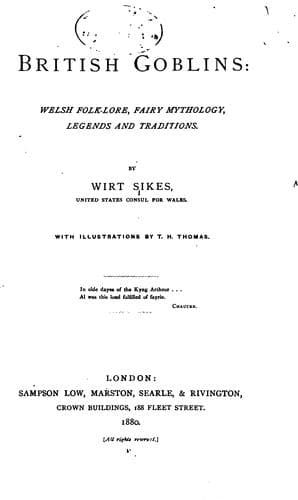
British Goblins: Welsh Folk-lore, Fairy Mythology, Legends and TraditionsSikes, Wirt
History
British Goblins: Welsh Folk-lore, Fairy Mythology, Legends and Traditions
Sikes, Wirt
Folklore -- Wales; Goblins -- Wales; Mythology, Celtic -- Wales; Mythology, Welsh; Wales -- Social life and customs
'And upon that he placed the white staff in Angharad's hand, and
instantly the goblin which she had hitherto seen as a handsome and
honourable nobleman, appeared to her as a monster, inconceivably
hideous; and she fainted from fear, and Einion supported her until she
revived. And when she opened her eyes, she saw there neither the
goblin, nor any of the guests, nor of the minstrels, nor anything
whatever except Einion, and her son, and the harp, and the house in
its domestic arrangement, and the dinner on the table, casting its
savoury odour around. And they sat down to eat ... and exceeding great
was their enjoyment. And they saw the illusion which the demoniacal
goblin had cast over them.... And thus it ends.'[81]
FOOTNOTE:
[81] Iolo MSS. 587, et seq.
V.
There is hardly a goblin in the world more widely known than this
spectre of the forest. Her story appears in the legends of very many
lands, including China. Its ancient Grecian prototype is found in the
Odyssey.[82]
When it is the Diawl himself who appears in the role of the familiar
spirit, his majesty is usually in some other form than that of a man,
with hoofs, horns, and tail. The orthodox form of Satan has indeed
been seen in many parts of Wales, but not when doing duty as a
familiar spirit. A Welsh poet of the thirteenth century mentions this
form:
And the horned devil,
With sharp hoofs
On his heels.[83]
He is variously called cythraul, dera, diafol, all euphemisms for
devil, equivalent to our destroyer, evil one, adversary--as well as
plain diawl, devil. In his character of a familiar spirit he assumes
the shape of a fiery ball, a donkey, a black calf, a round bowl, a
dog, a roaring flame, a bull, a goose, and numberless others,
including the imp that goes into a book. In all this he bears out the
character given him in old mythology, where he grows big or little at
pleasure, and roars in a gale as Hermes, the wind-god, howls as a dog,
enters a walnut as in the Norse Tale, or is confined in a bottle as
the genie of the 'Arabian Nights.'
To that eminent nonconformist preacher, Vavasor Powell, the devil
once appeared in shape like a house. 'Satan ... appeared several
times, and in several wayes, to me: as once like a house, stood
directly in my way, with which sight I fell on my face as dead....
Another time, being alone in my chamber ... I perceived a strong cold
wind to blow ... it made the hair of my flesh to stand up, and caused
all my bones to shake; and on the suddain, I heard one walk about me,
tramping upon the chamber floor, as if it had been some heavie big man
... but it proved in the end to be no other than ... Satan.'[84]
Public-domain text, read in full here on John Shaqi.
Reviews
Reviews
No reviews yet
Be the first to share your thoughts on this work.
Elsewhere in the archive
Join the Discussion
Join the discussion
Sign in to leave a comment or review.
Sign InorCreate an account