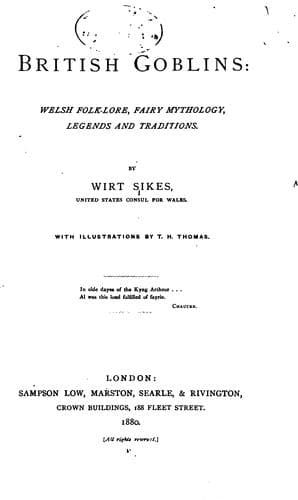
British Goblins: Welsh Folk-lore, Fairy Mythology, Legends and TraditionsSikes, Wirt
History
British Goblins: Welsh Folk-lore, Fairy Mythology, Legends and Traditions
Sikes, Wirt
Folklore -- Wales; Goblins -- Wales; Mythology, Celtic -- Wales; Mythology, Welsh; Wales -- Social life and customs
A black calf, which haunted a Pembrokeshire brook early in the present
century, was believed to be the devil in familiar guise. It appeared
at a certain spot near the village of Narberth--a village which has
figured actively in mythic story since the earliest ages of which
there is any record. One night two peasants caught the terrible calf
and took it home, locking it up safely in a stable with some other
cattle, but it had vanished when morning came.
Henry Llewelyn, of Ystrad Defoc parish, Glamorganshire, was beset by
the devil in the shape of a round bowl. He had been sent by his
minister (Methodist) to fetch from another parish a load of religious
books--Bibles, Testaments, Watts' 'Psalms, Hymns and Songs for
Children'--and was coming home with the same, on horseback, by night,
when he saw a living thing, round like a bowl, moving to and fro
across the lane. The bold Llewelyn having concluded it was the devil,
resolved to speak to it. 'What seekest thou, thou foul thing?' he
demanded, adding, 'In the name of the Lord Jesus go away!' And to
prove that it was the adversary, at these words it vanished into the
ground, leaving a sulphurous smell behind.
To William Jones, a sabbath-breaker, of Risca village, the devil
appeared as an enormous mastiff dog, which transformed itself into a
great fire and made a roaring noise like burning gorse. And to two men
at Merthyr Tydfil, in Glamorganshire, the fiend appeared in the shape
of a gosling. These men were one night drinking together at the Black
Lion Inn, when one dared the other to go to conjure. The challenge was
accepted, and they went, but conducted their emprise with such drunken
recklessness, that the devil put out the eyes of one of them, so that
he was blind the rest of his days.
FOOTNOTES:
[82] In his fascinating essay on the 'Folk-Lore of France,' in the
'Folk-Lore Record' for 1878 (published by the Folk-Lore Society) Mr.
A. Lang says: 'So widespread is this superstition, that a friend of
mine declares he has met with it among the savages of New Caledonia,
and has known a native who actually died, as he himself said he would,
after meeting one of the fairy women of the wild wood.'
[83] Gruffydd ab yr Ynad Coch.
[84] 'The Life and Death of Mr. Vavasor Powell,' p. 8. (A curious
seventeenth century book, no two existing copies of which appear to be
alike. I here cite from that in the library of the Marquis of Bute,
than which a more perfect copy is rarely met with.)
VI.
Public-domain text, read in full here on John Shaqi.
Reviews
Reviews
No reviews yet
Be the first to share your thoughts on this work.
Elsewhere in the archive
Join the Discussion
Join the discussion
Sign in to leave a comment or review.
Sign InorCreate an account