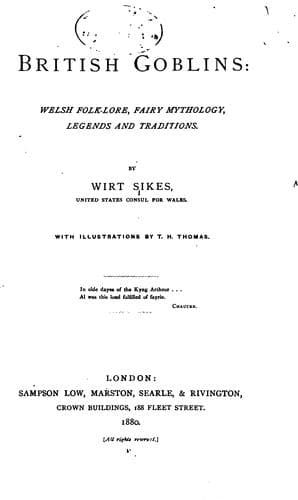
British Goblins: Welsh Folk-lore, Fairy Mythology, Legends and TraditionsSikes, Wirt
History
British Goblins: Welsh Folk-lore, Fairy Mythology, Legends and Traditions
Sikes, Wirt
Folklore -- Wales; Goblins -- Wales; Mythology, Celtic -- Wales; Mythology, Welsh; Wales -- Social life and customs
The devil has often appeared in Wales in his customary form, or with
his distinctive marks covered up by such clothing as mortals wear.
There was even a tailor in Cardiganshire who had the honour of making
a suit of clothes for his sulphuric majesty. The medieval view of this
malignant spirit--which makes the devil out as dull and stupid as he
is mendacious and spiteful--still lingers in some parts. Those formal
pacts with the devil, the first traces of which are found in the
twelfth and thirteenth centuries, have been made in great numbers in
Wales; and tales in which the devil is outwitted by a mortal are still
preserved with much distinctness in various localities. That the myth
of Polyphemus reappears in all accounts of this sort, is pretty well
agreed among students of folk-lore. Hercules and Cacus, Polyphemus and
Odysseus, Peredur and the one-eyed monster of the Mabinogion,
Gambrinus and der Teufel, Jack the Giant-Killer, Norse Jötuns and
Arabian genii tricked and bottled; all these are deemed outgrowths of
the same primeval idea, to wit, the victory of the sun-god over the
night-fiend; and the story of Sion Cent's compact with the diawl is
doubtless from the same root. Certain it is that were not the devil at
times gullible, he never would have been so useful as a familiar
spirit, never could have been made so completely a slave to his mortal
masters. The Pope (Benedict IX.) who had seven evil spirits in a
sugar-bottle, merely subdivided the arch-fiend in the same way the
genii of the old tales are subdivided--now existing as a dense and
visible form, again expanding to blot out the sky, and again entering
the narrow compass of a bottle or a nut-shell; co-existing in a
million places at the same instant, yet having a single individuality.
II.
Public-domain text, read in full here on John Shaqi.
Reviews
Reviews
No reviews yet
Be the first to share your thoughts on this work.
Elsewhere in the archive
Join the Discussion
Join the discussion
Sign in to leave a comment or review.
Sign InorCreate an account