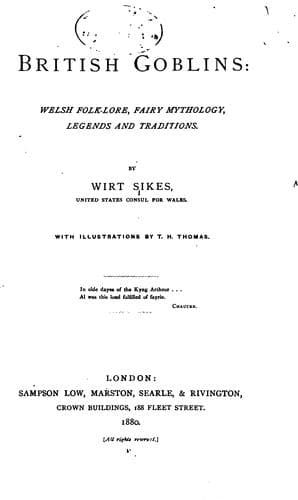
British Goblins: Welsh Folk-lore, Fairy Mythology, Legends and TraditionsSikes, Wirt
History
British Goblins: Welsh Folk-lore, Fairy Mythology, Legends and Traditions
Sikes, Wirt
Folklore -- Wales; Goblins -- Wales; Mythology, Celtic -- Wales; Mythology, Welsh; Wales -- Social life and customs
has taken the place, for public use, of the old bridge on the road to
Andermatt, and to the dangers of the crumbling masonry are added
superstitious terrors concerning the devil's power to catch any one
crossing after dark. The old Welsh bridge has been in like manner
superseded by a modern structure; but I think no superstition like the
last noted is found at Hafod.
V.
The English have a saying that the devil lives in the middle of Wales.
There is in every part of Wales that I have seen a custom of whitening
the doorsteps with chalk, and it is said to have originated in the
belief that his Satanic majesty could not enter a door thus protected.
The devil of slovenliness certainly would find difficulty in entering
a Welsh cottage if the tidiness of its doorstep is borne out in the
interior. But out-of-doors everywhere there are signs of the devil's
active habits. His flowers grow on the river-banks; his toes are
imprinted on the rocks. Near Tintern Abbey there is a jutting crag
overhung by gloomy branches of the yew, called the Devil's Pulpit. His
eminence used in other and wickeder days to preach atrocious morals,
or immorals, to the white-robed Cistercian monks of the abbey, from
this rocky pulpit. One day the devil grew bold, and taking his tail
under his arm in an easy and _dégagée_ manner, hobnobbed familiarly
with the monks, and finally proposed, just for a lark, that he should
preach them a nice red-hot sermon from the rood-loft of the abbey. To
this the monks agreed, and the devil came to church in high glee. But
fancy his profane perturbation (I had nearly written holy horror) when
the treacherous Cistercians proceeded to shower him with holy water.
The devil clapped his tail between his legs and scampered off howling,
and never stopped till he got to Llandogo, where he leaped across the
river into England, leaving the prints of his talons on a stone.
VI.
Where accounts of the devil's appearance are so numerous, it is
perhaps somewhat surprising so little is heard of apparitions of
angels. There are reasons for this, however, which might be enlarged
upon. Tradition says that 'in former times' there were frequent visits
of angels to Wales; and their rare appearance in our days is ascribed
to the completion of revelation. One or two modern instances of
angelic visitation are given by the Prophet Jones. There was David
Thomas, who lived at a place called the Pantau, between the towns of
Carmarthen and Laugharne; he was 'a gifted brother, who sometimes
preached,' in the dissenting way. One night, when he was at prayer
alone in a room which stood apart from his house, there was suddenly a
great light present, which made the light of the candle no longer
visible. And in that light appeared a band of angels, like children,
very beautiful in bright clothing, singing in Welsh these words:
Pa hyd? Pa hyd? Dychwelwch feibion Adda!
Pa hyd? Pa hyd yr erlidiwch y Cristnogion duwiol?
Public-domain text, read in full here on John Shaqi.
Reviews
Reviews
No reviews yet
Be the first to share your thoughts on this work.
Elsewhere in the archive
Join the Discussion
Join the discussion
Sign in to leave a comment or review.
Sign InorCreate an account