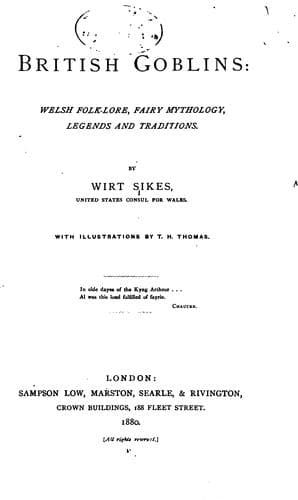
British Goblins: Welsh Folk-lore, Fairy Mythology, Legends and TraditionsSikes, Wirt
History
British Goblins: Welsh Folk-lore, Fairy Mythology, Legends and Traditions
Sikes, Wirt
Folklore -- Wales; Goblins -- Wales; Mythology, Celtic -- Wales; Mythology, Welsh; Wales -- Social life and customs
How long? How long? Return ye sons of Adam!
How long? How long will ye persecute the godly Christians?
After a time they departed; reappeared; departed again; the great
light faded; and the light of Mr. Thomas's candle was once more
visible on his table. There was also Rees David, a man of more than
common piety, who lived in Carmarthenshire, near Whitlands. At the
time of his death, it was testified by 'several religious persons who
were in the room,' that there was heard, by them and by the dying man,
the singing of angels. It drew nearer and nearer as his death-struggle
grew imminent, and after his death they 'heard the pleasant
incomparable singing gradually depart, until it was out of hearing.'
That the dying do see something more, in the last moment of expiring
nature, than it is given to living eyes to see, is a cherished belief
by numberless Christian men and women, whom to suspect of
superstitious credulity were to grossly offend. This belief is based
on exclamations uttered by the dying, while with fixed and staring
eyes they appeared to gaze intently at some object not visible to the
bystanders. But that the bystanders also saw, or heard, voice or
vision from the Unknown, is not often pretended.
VII.
Reference has been made to the euphemisms in use among all peoples to
avoid pronouncing the name of the devil. That many good folk still
consider the word devil, lightly spoken, a profane utterance only
second to a similar utterance of God's name, is a curious survival of
old superstitions. No prohibition of this sort attaches to the words
demon, fiend, etc., nor to such euphemisms, common in both Welsh and
English, as the adversary, the evil one, etc. It is an old custom in
North Wales to spit at the name of the devil, even when so innocently
used as in pronouncing the name of the Devil's Bridge. The peasantry
prefer to call the bridge 'Pont y Gwr Drwg,' the Bridge of the Wicked
One; and spitting and wiping off the tongue are deemed a necessary
precaution after saying devil, diafol, or diawl. The phrase 'I hope to
goodness,' so common in Wales and elsewhere, is clearly but another
euphemism for God; the goodness meant is the Divine beneficence.
'Goodness' sake' is but a contraction of 'For God's sake!' The Hebrew
tetragrammaton which was invested with such terror, as representing
the great 'I am,' finds an explanation, according to the ideas of
Welsh scholars, in the Bardic traditions. These relate that, by the
utterance of His Name, God created this world; the Name being
represented by the symbol /|\, three lines which typify the focusing
of the rising sun's rays at the equinoxes and solstices. The first ray
is the Creator, the second the Preserver, and the third the Destroyer;
the whole are God's Name. This name cannot be uttered by a mortal; he
has not the power; therefore it remains for ever unuttered on earth.
At the creation the universe uttered it in joy at the new-born world;
Public-domain text, read in full here on John Shaqi.
Reviews
Reviews
No reviews yet
Be the first to share your thoughts on this work.
Elsewhere in the archive
Join the Discussion
Join the discussion
Sign in to leave a comment or review.
Sign InorCreate an account