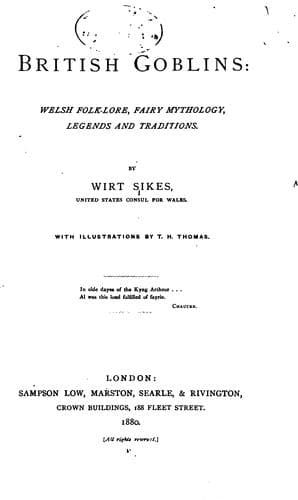
British Goblins: Welsh Folk-lore, Fairy Mythology, Legends and TraditionsSikes, Wirt
History
British Goblins: Welsh Folk-lore, Fairy Mythology, Legends and Traditions
Sikes, Wirt
Folklore -- Wales; Goblins -- Wales; Mythology, Celtic -- Wales; Mythology, Welsh; Wales -- Social life and customs
Listening at the church-door in the dark, to hear shouted by a ghostly
voice in the deserted edifice the names of those who are shortly to be
buried in the adjoining churchyard, is a Hallow E'en custom in some
parts of Wales. In other parts, the window serves the same purpose.
There are said to be still extant, outside some village churches,
steps which were constructed in order to enable the superstitious
peasantry to climb to the window to listen. The principle of
'expectant attention,' so well known to physiological science, would
be likely in this case to act with special force as a ghost-raiser. In
an ancient MS. by Llywelyn Sion, of Llangewydd, there is mention of a
frightful monster called the Fad Felen, which was seen through the
key-hole of Rhos church by Maelgwn Gwynedd, who 'died in consequence.'
This monster was predicted in a poem by Taliesin, as a 'strange
creature' which should come from the sea marsh, with hair and teeth
and eyes like gold. The yellow fever plague, which raged in Wales
during some five years in the sixth century, is the monster referred
to in this legend.
The Scotch wraith and Irish fetch have their parallel in Wales in the
Lledrith, or spectre of a person seen before his death; it never
speaks, and vanishes if spoken to. It has been seen by miners previous
to a fatal accident in the mine. The story is told of a miner who saw
himself lying dead and horribly maimed in a phantom tram-car, led by a
phantom horse, and surrounded by phantom miners. As he watched this
dreadful group of spectres they passed on, looking neither to the
right nor the left, and faded away. The miner's dog was as frightened
as its master at the sight, and ran howling into the darkness. Though
deeming himself doomed, the miner continued to work in the pit; and as
the days passed on, and no harm came to him, he grew more cheerful,
and was so bold as to laugh at the superstition. The day he did this,
a stone fell from the roof and broke his arm. As soon as he recovered
he resumed work in the pit; his death followed instantly. A stone
crushed him, and he was borne maimed and dead in the tram along the
road where his lledrith had appeared, 'a mile below the play of
sunshine and wave of trees.'[93]
The Mallt y Nos, or night-fiend, is a death-omen mentioned by Rev.
D. R. Thomas in the 'Archæologia Cambrensis'; and Croker[94] gives as
the Welsh parallel of the Irish death-coach a spectre called ceffyl
heb un pen, or the headless horse. The marw coel, or 'yellow spot
before death,' is another death-omen which I have been able to trace
no further than the pages where I find it.[95]
FOOTNOTES:
[88] 'Dewch! dewch!'
[89] 'Cymru Fu,' 299.
[90] 'Camb. Quarterly,' iv., 487.
[91] 'Arch. Camb.' 4th Se., iii., 333.
[92] Brand, 'Pop. Ant.' iii., 127.
[93] 'Tales and Sketches of Wales,' in 'Weekly Mail.'
[94] 'Fairy Legends of the South of Ireland,' 341.
[95] 'The Vale of Glamorgan.'
II.
Public-domain text, read in full here on John Shaqi.
Reviews
Reviews
No reviews yet
Be the first to share your thoughts on this work.
Elsewhere in the archive
Join the Discussion
Join the discussion
Sign in to leave a comment or review.
Sign InorCreate an account