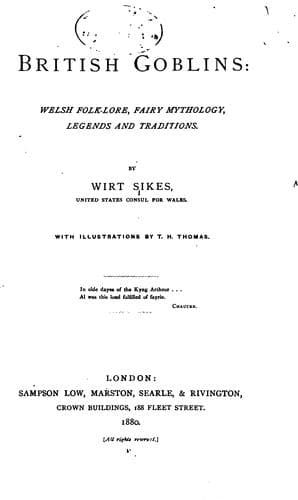
British Goblins: Welsh Folk-lore, Fairy Mythology, Legends and TraditionsSikes, Wirt
History
British Goblins: Welsh Folk-lore, Fairy Mythology, Legends and Traditions
Sikes, Wirt
Folklore -- Wales; Goblins -- Wales; Mythology, Celtic -- Wales; Mythology, Welsh; Wales -- Social life and customs
Thunder and lightning in mid-winter announce the death of the great
man of the parish. This superstition is thought to be peculiar to
Wales, or to the wilder and more secluded parts of North Wales.[91]
Also deemed peculiar to Wales is the Tan-wedd, a fiery apparition
which falls on the lands of a freeholder who is about to die. It is
described as appearing somewhat similar to falling stars, but slower
of motion. 'It lighteneth all the air and ground where it passeth,'
says 'the honest Welshman, Mr. Davis, in a letter to Mr. Baxter,'
adding, 'lasteth three or four miles or more, for aught is known,
because no man seeth the rising or beginning of it; and when it falls
to the ground it sparkleth and lighteth all about.'[92] It also comes
as a duty-performing goblin, after a death, haunting the graveyard,
and calling attention to some special grave by its conduct, as in the
following account: Walter Watkins, of the Neuadd, in a parish of
Brecknockshire, was going one dark night towards Taf Fechan Chapel,
not far from his house, when he saw a light near the chapel. It
increased till it was as big as a church tower, and decreased again
till it was as small as a star; then enlarged again and decreased as
before; and this it did several times. He went to his house and
fetched his father and mother to see it, and they all saw it plainly,
much to their astonishment and wonder. Some time after, as a neighbour
was ploughing in a field near the chapel, about where the mysterious
light had been seen, the plough struck against a large flat stone.
This the ploughman raised up, after a deal of difficulty, and under it
he found a stone chest, in which was the jawbone of a man, and nought
else except an earthen jug. The bone was supposed to be the remains of
a man who had disappeared long before, and whose wife had since
married; and on her being told of it, she fell ill and died. The
light, which had often been seen before by various persons, was after
this seen no more. It was believed to be the spirit of the murdered
man, appearing as a light.
Public-domain text, read in full here on John Shaqi.
Reviews
Reviews
No reviews yet
Be the first to share your thoughts on this work.
Elsewhere in the archive
Join the Discussion
Join the discussion
Sign in to leave a comment or review.
Sign InorCreate an account