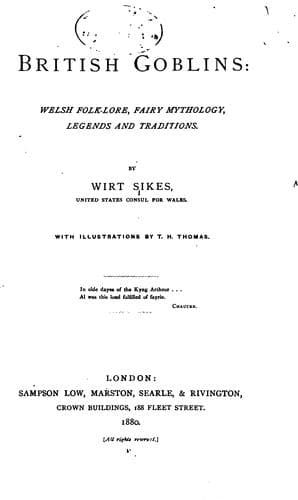
British Goblins: Welsh Folk-lore, Fairy Mythology, Legends and TraditionsSikes, Wirt
History
British Goblins: Welsh Folk-lore, Fairy Mythology, Legends and Traditions
Sikes, Wirt
Folklore -- Wales; Goblins -- Wales; Mythology, Celtic -- Wales; Mythology, Welsh; Wales -- Social life and customs
An instance of recent occurrence is given by a local newspaper
correspondent writing from the scene of a Welsh railway accident in
October, 1878. It was at Pontypridd, famous the world over for its
graceful bridge, (now old and superannuated,) and renowned in Druidic
story as a seat of learning. A victim of the railway accident was, a
few days before the collision, 'sitting with his wife at the fireside,
when he had an omen. The house was still, and they were alone, only a
little servant girl being with them. Then, while so sitting and
talking, they both heard a heavy footstep ascending the stairs, step
by step, step by step, as that of one carrying a burden. They looked
at one another, and the husband called, "Run, Mary, upstairs; some one
has gone up." Mary did run, but there was no one. She was told to look
in every room, and she did so, and it was put down as fancy. When the
news was borne to the poor wife on Saturday night, she started up and
said, "There now, that was the omen!"'[100] That his readers may not
by any perversity fail to understand him as alluding to the Tolaeth
before Death, our newspaper correspondent states his creed: 'I believe
in omens. I knew a lady who heard distinctly three raps at her door.
Another lady was sitting with her near it too. The door was an inner
door. No servant was in the house. The two ladies heard it, and yet no
human hand touched that door, and at the time when the knock was heard
a dear brother was dying. I know of strange things of this sort. Of
voices crying the names of half-sleeping relatives when the waves were
washing some one dear away to the mighty deep; but then the world
laughs at all this and the world goes on.' The correspondent is
severe; there is nothing here to laugh at.
FOOTNOTE:
[100] 'Western Mail,' Oct. 23, 1878.
IV.
The Tolaeth has one other form--that of a Voice which speaks, in a
simple and natural manner, but very significant words. Thus Edward
Lloyd, in the parish of Llangurig, was lying very ill, when the people
that were with him in his chamber heard a voice near them, but could
see no one; nor could they find any one anywhere about the house, to
whom the voice might belong. Soon afterwards they heard it utter, so
distinctly that it seemed to be in the room where they were, these
words, 'Y mae nenbren y t[^y] yn craccio,' (the upper beam of the
house cracketh.) Soon the Voice spoke again, saying, 'Fe dor yn y
man,' (it will presently break.) And once more it spoke: 'Dyna fe yn
tori,' (there it breaks.) That moment the sick man gave up the ghost.
Public-domain text, read in full here on John Shaqi.
Reviews
Reviews
No reviews yet
Be the first to share your thoughts on this work.
Elsewhere in the archive
Join the Discussion
Join the discussion
Sign in to leave a comment or review.
Sign InorCreate an account