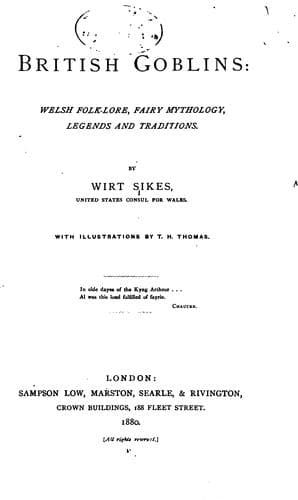
British Goblins: Welsh Folk-lore, Fairy Mythology, Legends and TraditionsSikes, Wirt
History
British Goblins: Welsh Folk-lore, Fairy Mythology, Legends and Traditions
Sikes, Wirt
Folklore -- Wales; Goblins -- Wales; Mythology, Celtic -- Wales; Mythology, Welsh; Wales -- Social life and customs
John, the son of Watkin Elias Jones, of the parish of Mynyddyslwyn,
was one day ploughing in the field, when the oxen rested, and he sent
the lad who drove the oxen, to fetch something which he wanted; and
while thus alone in the field, he saw a cloud coming across the field
to him. When the cloud had come to that part of the field where he
was, it stopped, and shadowed the sun from him; and out of the cloud
came a Voice, which asked him which of these three diseases he would
choose to die of--fever, dropsy, or consumption. Being a man who could
give a plain answer to a plain question, he replied that he would
rather die of consumption. The lad now returning, he sent him home
with the oxen, and then, feeling inclined to sleep, lay down and
slept. When he awoke he was ill, and fell by degrees into a
consumption, of which he died one year from the day of this warning.
He did not tell of this apparition, however, until within six weeks of
his death.
V.
One of the most beautiful legends in the Iolo MSS. gives an ancient
tale of the Tolaeth which may be thus condensed: A great and wealthy
lord, rich in land, houses and gold, enjoying all the luxuries of
life, heard a voice proclaim thrice distinctly: 'The greatest and
richest man of this parish shall die to-night.' At this he was sadly
troubled, for he knew that the greatest and richest man of that parish
could be no other than he; so he sent for the physician, but made
ready for death. Great, however, was his joy when the night passed,
the day broke, and he was yet alive. At sunrise the church bell was
heard tolling, and the lord sent in haste to know who was dead. Answer
came that it was an old blind beggar man, who had asked, and been
refused, alms at the great man's gate. Then the lord knew the meaning
of the warning voice he had heard: that very great and very rich man
had been the poor beggar--his treasures and wealth in the kingdom of
heaven. He took the warning wisely to heart, endowed religious houses,
relieved all who were in poverty, and when at last he was dying, the
voices of angels were heard to sing a hymn of welcome; and he was
buried, according to his desire, in the old beggar's grave.[101]
FOOTNOTE:
[101] Iolo MSS., 592.
VI.
Public-domain text, read in full here on John Shaqi.
Reviews
Reviews
No reviews yet
Be the first to share your thoughts on this work.
Elsewhere in the archive
Join the Discussion
Join the discussion
Sign in to leave a comment or review.
Sign InorCreate an account