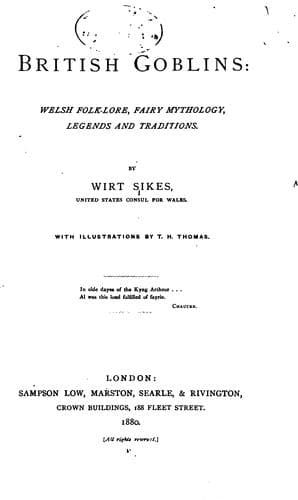
British Goblins: Welsh Folk-lore, Fairy Mythology, Legends and TraditionsSikes, Wirt
History
British Goblins: Welsh Folk-lore, Fairy Mythology, Legends and Traditions
Sikes, Wirt
Folklore -- Wales; Goblins -- Wales; Mythology, Celtic -- Wales; Mythology, Welsh; Wales -- Social life and customs
An old man who resided near Llanllwch church, in Carmarthenshire, used
to assert in the most solemn manner that he had seen the Teulu going
to church again and again. On a certain evening hearing one
approaching, he peeped over a wall to look at it. The persons
composing the procession were all acquaintances of his, with the
exception of one who stood apart from the rest, gazing mournfully at
them, and who appeared to be a stranger. Soon afterwards there was a
real burying, and the old man, determined to see if there would be in
the scene any resemblance to his last Teulu, went to the churchyard
and waited. When the procession arrived, all were there as he had seen
them, except the stranger. Looking about him curiously, the old man
was startled by the discovery that he was himself the stranger! He was
standing on the identical spot where had stood the man he did not
recognise when he saw the Teulu. It was his own ghost.
FOOTNOTE:
[102] 'Account of the Parish of Aberystruth,' 17.
VII.
The death portent called Cwn Annwn, or Dogs of Hell, is a pack of
hounds which howl through the air with a voice frightfully
disproportionate to their size, full of a wild sort of lamentation.
There is a tradition that one of them once fell on a tombstone, but no
one was able to secure it. A peculiarity of these creatures is that
the nearer they are to a man the less loud their voice sounds,
resembling then the voice of small beagles, and the farther off they
are the louder is their cry. Sometimes a voice like that of a great
hound is heard sounding among them--a deep hollow voice, as if it were
the voice of a monstrous bloodhound. Although terrible to hear, and
certain portents of death, they are in themselves harmless. 'They have
never been known,' says a most respectable authority,[103] 'to commit
any mischief on the persons of either man or woman, goat, sheep, or
cow.' Sometimes they are called Cwn y Wybr, or Dogs of the Sky, but
the more sulphurous name is the favourite one. They are also
sometimes called Dogs of the Fairies. Their origin in fairyland is
traced to the famous mabinogi of Pwyll, Prince of Dyfed; but in that
fascinating tale of enchantment their right to be called Cwn Annwn is
clearly set forth, for they are there the hounds of a King of Annwn.
There are several translations of this mabinogi in existence, and its
popularity in South Wales is great, for the villages, vales, and
streams mentioned in it are familiar to residents in Pembroke,
Carmarthen, and Cardigan shires. Pwyll, the Prince, was at Narberth,
where was his chief palace, when he went one day to a wood in Glyn
Cych. Here 'he sounded his horn and began to enter upon the chase,
following his dogs and separating from his companions. And as he was
listening to the cry of his pack, he could distinctly hear the cry of
another pack, different from that of his own, and which was coming in
an opposite direction. He could also discern an opening in the woods
Public-domain text, read in full here on John Shaqi.
Reviews
Reviews
No reviews yet
Be the first to share your thoughts on this work.
Elsewhere in the archive
Join the Discussion
Join the discussion
Sign in to leave a comment or review.
Sign InorCreate an account