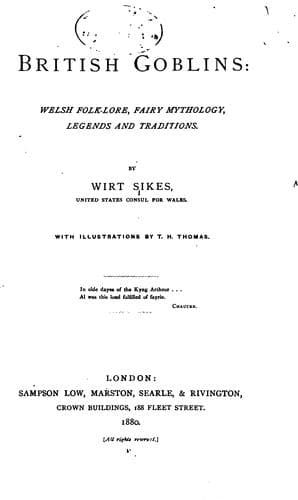
British Goblins: Welsh Folk-lore, Fairy Mythology, Legends and TraditionsSikes, Wirt
History
British Goblins: Welsh Folk-lore, Fairy Mythology, Legends and Traditions
Sikes, Wirt
Folklore -- Wales; Goblins -- Wales; Mythology, Celtic -- Wales; Mythology, Welsh; Wales -- Social life and customs
towards a level plain; and as his pack was entering the skirt of the
opening he perceived a stag before the other pack, and about the
middle of the glade the pack in the rear coming up and throwing the
stag on the ground. Upon this he fixed his attention on the colour of
the pack, without recollecting to look at the stag: and of all the
hounds in the world he had ever seen he never saw any like them in
colour. Their colour was a shining clear white, with red ears; and the
whiteness of the dogs and the redness of their ears were equally
conspicuous.'[104] They were the hounds of Arawn, a crowned king in
the land of Annwn, the shadow-land of Hades.
The Cwn Annwn are sometimes held to be the hell-hounds which hunt
through the air the soul of the wicked man, the instant it quits the
body--a truly terrific idea to the vulgar mind. The Prophet Jones has
several accounts of them: Thomas Phillips, of Trelech parish, heard
them with the voice of the great dog sounding among them, and noticed
that they followed a course that was never followed by funerals, which
surprised him very much, as he had always heard that the Dogs of the
Sky invariably went the same way that the corpse was to follow. Not
long after a woman from an adjoining parish died at Trelech, and being
carried to her own parish church to be buried, her corpse did actually
pass the same way in which the spirit dogs had been heard to hunt.
Thomas Andrew, of the parish of Llanhiddel, heard them one night as he
was coming home. 'He heard them coming towards him, though he saw them
not.' Their cry grew fainter as they drew near him, passed him, and
louder again as they went from him. They went down the steeps towards
the river Ebwy. And Thomas Andrew was 'a religious man, who would not
have told an untruth for fear or for favour.'
FOOTNOTES:
[103] 'Cambro-Briton,' i., 350.
[104] Dr. W. Owen Pughe's Trans., 'Camb.-Briton,' ii., 271.
VIII.
Public-domain text, read in full here on John Shaqi.
Reviews
Reviews
No reviews yet
Be the first to share your thoughts on this work.
Elsewhere in the archive
Join the Discussion
Join the discussion
Sign in to leave a comment or review.
Sign InorCreate an account