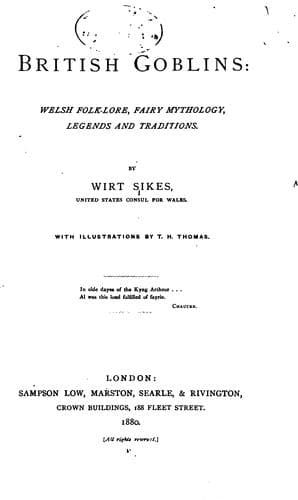
British Goblins: Welsh Folk-lore, Fairy Mythology, Legends and TraditionsSikes, Wirt
History
British Goblins: Welsh Folk-lore, Fairy Mythology, Legends and Traditions
Sikes, Wirt
Folklore -- Wales; Goblins -- Wales; Mythology, Celtic -- Wales; Mythology, Welsh; Wales -- Social life and customs
The Corpse Candle--Its Peculiarities--The Woman of
Caerau--Grasping a Corpse Candle--The Crwys Candle--Lights
issuing from the Mouth--Jesting with the Canwyll Corph--The
Candle at Pontfaen--The Three Candles at Golden
Grove--Origin of Death-Portents in Wales--Degree of Belief
prevalent at the Present Day--Origin of Spirits in
General--The Supernatural--The Question of a Future Life.
I.
Perhaps the most picturesque of the several death-omens popular in
Wales is the Canwyll Corph, or Corpse Candle. It is also, according to
my observation, the most extensively believed in at the present day.
Its details are varied and extremely interesting. The idea of a goblin
in the form of a lighted tallow candle is ludicrous enough, at first
sight; and indeed I know several learned Welsh gentlemen who venture
to laugh at it; but the superstition grows more and more grim and less
risible the better one becomes acquainted with it. It is worth noting
here that the canwyll, or candle, is a more poetic thing among the
Welsh--has a higher literary place, so to speak--than among
English-speaking peoples. In the works of their ancient poets the
candle is mentioned in passages where we should use the word light or
lamp--as in this verse, which is attributed to Aneurin (sixth
century):
The best candle for man is prudence.
The candle is the favourite figure for mental guidance among the
Welsh;[107] there is no book in the Welsh language so popular as a
certain work of religious counsel by a former Vicar of Llandovery,
called 'The Candle of the Cymry.' The Corpse Candle is always and
invariably a death-warning. It sometimes appears as a stately
flambeau, stalking along unsupported, burning with a ghastly blue
flame. Sometimes it is a plain tallow 'dip' in the hand of a ghost,
and when the ghost is seen distinctly it is recognised as the ghost of
some person yet living, who will now soon die. This, it will be
noticed, is a variation upon the wraith, or Lledrith. Sometimes the
goblin is a light which issues from a person's mouth or nostrils.
According to the belief of some sections, the size of the candle
indicates the age of the person who is about to die, being large when
it is a full-grown person whose death is foretold, small when it is a
child, still smaller when an infant. Where two candles together are
seen, one of which is large and the other small, it is a mother and
child who are to die. When the flame is white, the doomed person is a
woman; when red, a man.
FOOTNOTE:
[107] Stephens, 'Lit. of the Kymry,' 287. (New Ed., 1876.)
II.
Public-domain text, read in full here on John Shaqi.
Reviews
Reviews
No reviews yet
Be the first to share your thoughts on this work.
Elsewhere in the archive
Join the Discussion
Join the discussion
Sign in to leave a comment or review.
Sign InorCreate an account