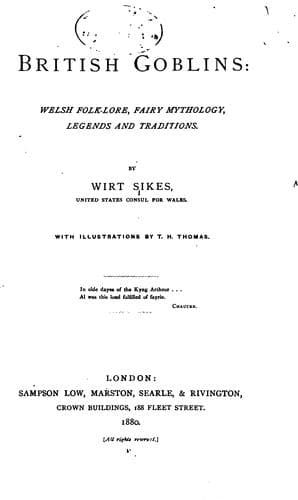
British Goblins: Welsh Folk-lore, Fairy Mythology, Legends and TraditionsSikes, Wirt
History
British Goblins: Welsh Folk-lore, Fairy Mythology, Legends and Traditions
Sikes, Wirt
Folklore -- Wales; Goblins -- Wales; Mythology, Celtic -- Wales; Mythology, Welsh; Wales -- Social life and customs
Among the accounts of the Corpse Candle which have come under my
notice none are more interesting than those given me by a good dame
whom I encountered at Caerau, near Cardiff. Caerau is a little village
of perhaps one hundred souls, crouched at the foot of a steep hill on
whose summit are the ancient earthworks of a Roman camp. On this
summit also stands the parish church, distinctly visible from Cardiff
streets, so ponderous is its square tower against the sky. To walk
there is a pleasant stroll from the late Marquis of Bute's statue in
the centre of the seaport town. I am thus particular merely for
emphasis of the fact that this superstition is not confined to remote
and out-of-the-way districts. Caerau is rural, and its people are all
poor people, perhaps; but its church is barely three miles from the
heart of a busy seaport. In this church I met the voluble Welshwoman
who gave me the accounts referred to. One was to this effect: One
night her sister was lying very ill at the narrator's house, and she
was alone with her children, her husband being in the lunatic asylum
at Cardiff. She had just put the children to bed, and had set her
candle on the floor preparatory to going to bed herself, when there
came a 'swish' along the floor, like the rustling of grave-clothes,
and the candle was blown out. The room, however, to her surprise,
remained glowing with a feeble light as from a very small taper, and
looking behind her she beheld 'old John Richards,' who had been dead
ten years. He held a Corpse Candle in his hand, and he looked at her
in a chill and steadfast manner which caused the blood to run cold in
her veins. She turned and woke her eldest boy, and said to him, 'Don't
you see old John Richards?' The boy asked 'Where?' rubbing his eyes.
She pointed out the ghost, and the boy was so frightened at sight of
it that he cried out 'O wi! O Dduw! I wish I may die!' The ghost then
disappeared, the Corpse Candle in its hand; the candle on the floor
burned again with a clear light, and the next day the sick sister
died.
Another account ran somewhat thus: The narrator's mother-in-law was
ill with a cancer of the breast. 'Jenny fach,' she said to the
narrator one night, 'sleep by me--I feel afraid.' 'Hach!' said Jenny,
thinking the old woman was foolishly nervous; but she stayed. As she
was lying in bed by the side of her mother-in-law, she saw at the foot
of the bed the faint flame of a Corpse Candle, which shed no light at
all about the room; the place remained as dark as it was before. She
looked at it in a sort of stupor for a short time, and then raised
herself slowly up in bed and reached out to see if she could grasp the
candle. Her fingers touched it, but it immediately went out in a
little shower of pale sparkles that fell downward. At that moment her
mother-in-law uttered a groan, and expired.
Public-domain text, read in full here on John Shaqi.
Reviews
Reviews
No reviews yet
Be the first to share your thoughts on this work.
Elsewhere in the archive
Join the Discussion
Join the discussion
Sign in to leave a comment or review.
Sign InorCreate an account