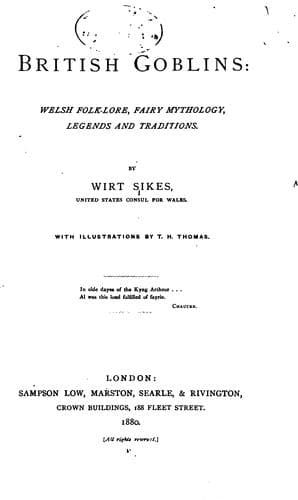
British Goblins: Welsh Folk-lore, Fairy Mythology, Legends and TraditionsSikes, Wirt
History
British Goblins: Welsh Folk-lore, Fairy Mythology, Legends and Traditions
Sikes, Wirt
Folklore -- Wales; Goblins -- Wales; Mythology, Celtic -- Wales; Mythology, Welsh; Wales -- Social life and customs
It is ill jesting with the Corpse Candle. Persons who have endeavoured
to stop it on its way have come severely to grief thereby. Many have
been struck down where they stood, in punishment of their audacity, as
in the case of William John, a blacksmith of Lanboydi. He was one
night going home on horseback, when he saw a Corpse Candle, and his
natural caution being at the moment somewhat overcome by potables, he
resolved to go out of his way to obstruct its passage. As the candle
drew near he saw a corpse upon a bier, the corpse of a woman he knew,
and she held the candle between her forefingers, and dreadfully
grinned at him. Then he was struck from his horse, and lay in the road
a long time insensible, and was ill for weeks thereafter. Meantime,
the woman whose spectral corpse he had seen, died and was buried, her
funeral passing by that road.
A clergyman's son in Carmarthenshire, (subsequently himself a
preacher,) who in his younger days was somewhat vicious, came home one
night late from a debauch, and found the doors locked. Fearing to
disturb the folk, and fearing also their reproaches and chidings for
his staying out so late, (as many a young fellow has felt before and
since,) he went to the man-servant, who slept in an out-room, as is
sometimes the custom in Welsh rural districts. He could not awake the
man-servant, but while standing over him, he saw a small light issue
from the servant's nostrils, which soon became a Corpse Candle. He
followed it out. It came to a foot-bridge which crossed a rivulet.
Here the young man became inspired with the idea of trying an
experiment with the Corpse Candle. He raised the end of the
foot-bridge off the bank, and watched to see what the ghostly light
would do. When it came to the rivulet it seemed to offer to go over,
but hesitated, as if loth to cross except upon the bridge. So the
young man put the bridge back in its place, and stayed to see how the
candle would act. It came on the bridge, and as it passed the young
man it struck him, as with a handkerchief. But though the blow was
thus light and phantom-like, it doubled the young man up and left him
a senseless heap on the ground, where he lay till morning, when he
recovered and went home. It is needless to add that the servant died.
IV.
Public-domain text, read in full here on John Shaqi.
Reviews
Reviews
No reviews yet
Be the first to share your thoughts on this work.
Elsewhere in the archive
Join the Discussion
Join the discussion
Sign in to leave a comment or review.
Sign InorCreate an account