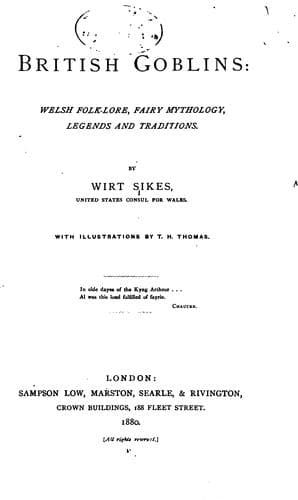
British Goblins: Welsh Folk-lore, Fairy Mythology, Legends and TraditionsSikes, Wirt
History
British Goblins: Welsh Folk-lore, Fairy Mythology, Legends and Traditions
Sikes, Wirt
Folklore -- Wales; Goblins -- Wales; Mythology, Celtic -- Wales; Mythology, Welsh; Wales -- Social life and customs
'Do you know Thomas Mathews, sir?' she asked me; 'he lives at Crwys
now, but he used to live here at Caerau.' 'Crwys?' I repeated, not at
once comprehending. 'Oh, you must know Crwys, sir; it's just the other
side of Cardiff, towards Newport.' 'Can you spell it for me?'[108] The
woman blushed. ''Deed, sir,' said she, 'I ought to be a scholar, but
I've had so much trouble with my old man that I've quite forgot my
spellin'.' However, the story of Thomas Mathews was to the effect that
he saw a Corpse Candle come out of his father's mouth and go to his
feet, and away a bit, then back again to the mouth, which it did not
exactly enter, but blended as it were with the sick man's body. I
asked if the candle was tallow at any point in its excursion, to which
I was gravely answered that it was the spirit of tallow. The man died
not long after, in the presence of my informant, who described the
incident with a dramatic force and fervour peculiarly Celtic,
concluding with the remark: 'Well, well, there's only one way to come
into the world, but there's a many ways to go out of it.'
The light issuing from the mouth is a fancy frequently encountered. In
the 'Liber Landavensis' it is mentioned that one day as St. Samson was
celebrating the holy mysteries, St. Dubricius with two monks saw a
stream of fire to proceed glittering from his mouth.[109] In old
woodcuts, the souls of the dying are represented as issuing from the
mouth in the form of small human figures; and the Tyrolese peasants
still fancy the soul is seen coming out of the mouth of a dying man
like a little white cloud.[110] From the mouth of a patient in a London
hospital some time since the nurses observed issuing a pale bluish
flame, and soon after the man died. The frightened nurses--not being
acquainted with the corpse-candle theory of such things--imagined the
torments of hell had already begun in the still living body. A
scientific explanation of the phenomenon ascribed it to phosphuretted
hydrogen, a result of incipient decomposition.[111]
FOOTNOTES:
[108] It is pronounced Croo-iss.
[109] 'Liber Landavensis,' 299.
[110] Tylor, 'Primitive Culture,' 391.
[111] 'Transactions Cardiff Nat. Soc.,' iv. 5.
III.
Public-domain text, read in full here on John Shaqi.
Reviews
Reviews
No reviews yet
Be the first to share your thoughts on this work.
Elsewhere in the archive
Join the Discussion
Join the discussion
Sign in to leave a comment or review.
Sign InorCreate an account