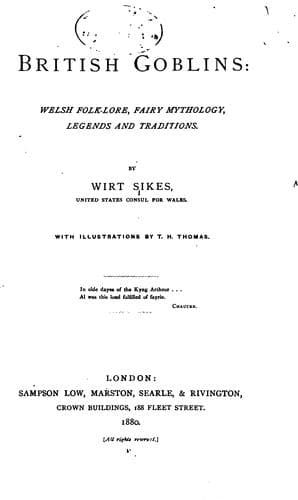
British Goblins: Welsh Folk-lore, Fairy Mythology, Legends and TraditionsSikes, Wirt
History
British Goblins: Welsh Folk-lore, Fairy Mythology, Legends and Traditions
Sikes, Wirt
Folklore -- Wales; Goblins -- Wales; Mythology, Celtic -- Wales; Mythology, Welsh; Wales -- Social life and customs
A happy new year to you,
Merry be your holidays,
Master and mistress--every one in the house;
Arise in the morning; bestir the fire,
And go to the well to fetch fresh water.
FOOTNOTE:
[113] Dennys, 'Folk-Lore of China,' 31.
III.
Among Twelfth Night customs, none is more celebrated than that called
Mary Lwyd. It prevails in various parts of Wales, notably in lower
Glamorganshire. The skeleton of a horse's head is procured by the
young men or boys of a village, and adorned with 'favours' of pink,
blue, yellow, etc. These are generally borrowed from the girls, as it
is not considered necessary the silken fillets and rosettes should be
new, and such finery costs money. The bottoms of two black bottles are
inserted in the sockets of the skeleton head to serve as eyes, and a
substitute for ears is also contrived. On Twelfth Night they carry
this object about from house to house, with shouts and songs, and a
general cultivation of noise and racket. Sometimes a duet is sung in
Welsh, outside a door, the singers begging to be invited in; if the
door be not opened they tap on it, and there is frequently quite a
series of _awen_ sung, the parties within denying the outsiders
admission, and the outsiders urging the same. At last the door is
opened, when in bounces the merry crowd, among them the Mary Lwyd,
borne by one personating a horse, who is led by another personating
the groom. The horse chases the girls around the room, capering and
neighing, while the groom cries, 'So ho, my boy--gently, poor fellow!'
and the girls, of course, scream with merriment. A dance follows--a
reel, performed by three young men, tricked out with ribbons. The
company is then regaled with cakes and ale, and the revellers depart,
pausing outside the door to sing a parting song of thanks and good
wishes to their entertainers.
The penglog (a skull, a noddle) is a similar custom peculiar to
Aberconwy (Conway) in Carnarvonshire. In this case the horse's skull
is an attention particularly bestowed upon prudes.
Mary Lwyd may mean Pale Mary, or Wan Mary, or Hoary Mary, but the
presumption is that it means in this case Blessed Mary, and that the
custom is of papal origin. There is, however, a tradition which links
the custom with enchantment, in connection with a warlike princess,
reputed to have flourished in Gwent and Morganwg in the early ages,
and who is to be seen to this day, mounted on her steed, on a rock in
Rhymney Dingle.[114]
The cutty wren is a Pembrokeshire Twelfth Night custom prevailing
commonly during the last century, but now nearly extinct. A wren was
placed in a little house of paper, with glass windows, and this was
hoisted on four poles, one at each corner. Four men bore it about,
singing a very long ballad, of which one stanza will be enough:
Public-domain text, read in full here on John Shaqi.
Reviews
Reviews
No reviews yet
Be the first to share your thoughts on this work.
Elsewhere in the archive
Join the Discussion
Join the discussion
Sign in to leave a comment or review.
Sign InorCreate an account