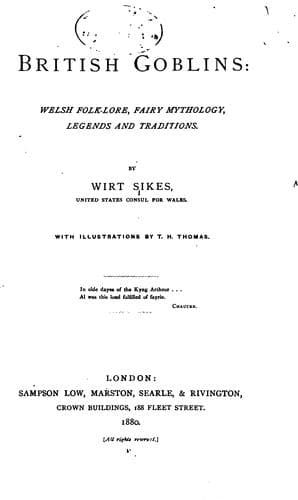
British Goblins: Welsh Folk-lore, Fairy Mythology, Legends and TraditionsSikes, Wirt
History
British Goblins: Welsh Folk-lore, Fairy Mythology, Legends and Traditions
Sikes, Wirt
Folklore -- Wales; Goblins -- Wales; Mythology, Celtic -- Wales; Mythology, Welsh; Wales -- Social life and customs
In Pembrokeshire, to rise early on New Year's morning is considered
luck-bringing. On that morning also it is deemed wise to bring a fresh
loaf into the house, with the superstition that the succession of
loaves throughout the year will be influenced by that incident. A
rigid quarantine is also set up, to see that no female visitor cross
the threshold first on New Year's morning; that a male visitor shall
be the first to do so is a lucky thing, and the reverse unlucky. A
superstition resembling this prevails to this day in America among
showmen. 'There's no showman on the road,' said an American manager of
my acquaintance, 'who would think of letting a lady be first to pass
through the doors when opening them for a performance. There's a sort
of feeling that it brings ill-luck. Then there are cross-eyed people;
many a veteran ticket-seller loses all heart when one presents himself
at the ticket-window. A cross-eyed patron and a bad house generally go
together. A cross-eyed performer would be a regular Jonah. With
circuses there is a superstition that a man with a yellow clarionet
brings bad luck.' Another well-known New York manager in a recent
conversation assured me that to open an umbrella in a new play is
deemed certain failure for the piece. An umbrella may be carried
closed with impunity, but it must not be opened unless the author
desire to court failure. The Chinese have the Pembrokeshire
superstition exactly, as regards the first foot on New Year's Day.
They consider a woman peculiarly unlucky as a first foot after the New
Year has begun, but a Buddhist priest is even more unlucky than a
woman, in this light.[113]
Another Pembrokeshire custom on New Year's morning is quaint and
interesting. As soon as it is light, children of the peasantry hasten
to provide a small cup of pure spring water, just from the well, and
go about sprinkling the faces of those they meet, with the aid of a
sprig of evergreen. At the same time they sing the following verses:
Here we bring new water from the well so clear,
For to worship God with, this happy new year;
Sing levy dew, sing levy dew, the water and the wine,
With seven bright gold wires, and bugles that do shine;
Sing reign of fair maid, with gold upon her toe;
Open you the west door and turn the old year go;
Sing reign of fair maid, with gold upon her chin;
Open you the east door and let the new year in!
This custom also is still observed extensively. The words 'levy dew'
are deemed an English version of Llef i Dduw, (a cry to God).
A Welsh song sung on New Year's Day, in Glamorganshire, by boys in
chorus, somewhat after the Christmas carol fashion, is this:
Blwyddyn newydd dda i chwi,
Gwyliau llawen i chwi,
Meistr a meistres bob un trwy'r ty,
Gwyliau llawen i chwi,
Codwch yn foreu, a rheswch y tan,
A cherddwch i'r ffynon i ymofyn dwr glan.
Public-domain text, read in full here on John Shaqi.
Reviews
Reviews
No reviews yet
Be the first to share your thoughts on this work.
Elsewhere in the archive
Join the Discussion
Join the discussion
Sign in to leave a comment or review.
Sign InorCreate an account