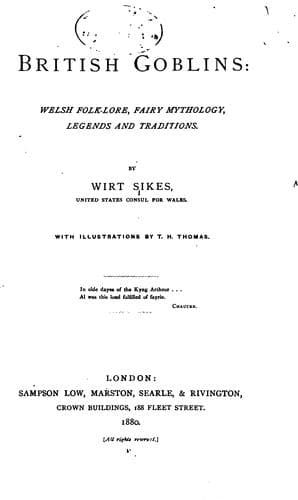
British Goblins: Welsh Folk-lore, Fairy Mythology, Legends and TraditionsSikes, Wirt
History
British Goblins: Welsh Folk-lore, Fairy Mythology, Legends and Traditions
Sikes, Wirt
Folklore -- Wales; Goblins -- Wales; Mythology, Celtic -- Wales; Mythology, Welsh; Wales -- Social life and customs
St. Dewi is to the Welsh what St. George is to the English, St. Andrew
to the Scotch, and St. Patrick to the Irish. His day is celebrated on
the 1st of March throughout Wales, and indeed throughout the world
where Welshmen are. In some American ports (perhaps all) the British
consulate displays its flag in honour of the day. In Wales there are
processions, grand dinners; places of business are closed; the poor
are banqueted; speeches are made and songs are sung. The most
characteristic feature of the day is the wearing of the leek. This
feature is least conspicuous, it may be noted, in those parts of Wales
where the English residents are fewest, and least of all in the
ultra-Welsh shires of Cardigan and Carmarthen, where St. David is
peculiarly honoured. The significance of this fact no doubt lies in
the absence of any necessity for asserting a Cambrianism which there
are none to dispute. In the border towns, every Welshman who desires
to assert his national right wears the leek in his hat or elsewhere on
his person; but in the shadow of St. David's College at Lampeter, not
a leek is seen on St. Dewi's Day. In Glamorganshire may be found the
order of Knights of the Leek, who hold high festival on the 1st of
every March, gathering in the Welsh bards and men of letters.
Why is the leek worn? Practically, because the wearer is a Welshman
who honours tradition. But the precise origin of the custom is
involved in an obscurity from which emerge several curious and
interesting traditions. The verses cited at the opening of this Part
refer to one of these; they are quoted by Manby[115] without other
credit than 'a very antient manuscript.' Another tradition is thus
given in a pamphlet of 1642:[116] 'S. David when hee always went into
the field in Martiall exercise he carried a Leek with him, and once
being almost faint to death, he immediately remembred himself of the
Leek, and by that means not only preserved his life but also became
victorious: hence is the Mythologie of the Leek derived.' The practice
is traced by another writer[117] to 'the custom of Cymhortha, or the
neighbourly aid practised among farmers, which is of various kinds.
In some districts of South Wales all the neighbours of a small farmer
without means appoint a day when they all attend to plough his land,
and the like; and at such a time it is a custom for each individual to
bring his portion of leeks, to be used in making pottage for the whole
company; and they bring nothing else but the leeks in particular for
the occasion.' Some find the true origin of the custom in Druidical
days, but their warrant is not clear, nor how it came to be associated
with the 1st of March in that case. The military origin bears down the
scale of testimony, and gives the leek the glory of a Cambrian victory
as its consecrator to ornamental purposes. Whether this victory was
over the Saxon or the Gaul does not exactly appear; some traditions
say one, some the other.
Public-domain text, read in full here on John Shaqi.
Reviews
Reviews
No reviews yet
Be the first to share your thoughts on this work.
Elsewhere in the archive
Join the Discussion
Join the discussion
Sign in to leave a comment or review.
Sign InorCreate an account