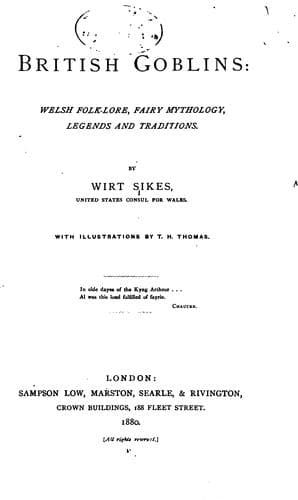
British Goblins: Welsh Folk-lore, Fairy Mythology, Legends and TraditionsSikes, Wirt
History
British Goblins: Welsh Folk-lore, Fairy Mythology, Legends and Traditions
Sikes, Wirt
Folklore -- Wales; Goblins -- Wales; Mythology, Celtic -- Wales; Mythology, Welsh; Wales -- Social life and customs
The first of April is in Welsh called Calan Ebrill, and an April Fool
a Ffwl Ebrill; the similarity of English and Welsh words may be said
to typify the similarity of observance. The universality of this
observance among Aryan peoples would certainly indicate an origin in a
time preceding the dispersion of the human family over the world. The
Druids, tradition says, celebrated the revival of Nature's powers in a
festival which culminated on the first of April in the most hilarious
foolery. The Roman Saturnalia or feast of fools perpetuated the rite,
though the purpose of the Christian revelry may quite possibly have
been to ridicule the Druidic ceremonies.
The festivities of May-day are in like manner associated with the
powers of Nature, whose vigour and productiveness were symbolized by
the Maypole round which village lads and lasses danced. The rites of
love were variously celebrated at this time, and some of these customs
locally have long survived the Maypole itself. The ordinance for the
destruction of Maypoles in England and Wales, printed in 1644,
declared them 'a heathenish vanity, generally abused to superstition
and wickedness,' wherefore it was ordained that they should be
destroyed, and that no Maypole should thereafter be 'set up, erected,
or suffered to be within this kingdom of England or dominion of
Wales.'
The Maypole in Wales was called Bedwen, because it was always made of
birch, bedw, a tree still associated with the gentler emotions. To
give a lover a birchen branch, is for a maiden to accept his
addresses; to give him a collen, or hazel, the reverse. Games of
various sorts were played around the bedwen. The fame of a village
depended on its not being stolen away, and parties were constantly on
the alert to steal the bedwen, a feat which, when accomplished, was
celebrated with peculiar festivities. This rivalry for the possession
of the Maypole was probably typical of the ancient idea that the first
of May was the boundary day dividing the confines of winter and
summer, when a fight took place between the powers of the air, on the
one hand striving to continue the reign of winter, on the other to
establish that of summer. Here may be cited the Mabinogi of Kilhwch
and Olwen, where it speaks of the daughter of Lludd Llaw Ereint. 'She
was the most splendid maiden in the three Islands of the Mighty, and
in the three Islands adjacent,' and for her does Gwyn ap Nudd, the
fairy king, fight every first of May till the day of doom.[126] She
was to have been the bride of Gwythyr, the son of Greidawl, when Gwyn
ap Nudd carried her off by force. The bereaved bridegroom followed,
and there was a bloody struggle, in which Gwyn was victorious, and
which he signalized by an act of frightful cruelty; he slew an old
warrior, took out his heart from his breast, and constrained the
warrior's son to eat the heart of his father. When Arthur heard of
this he summoned Gwyn ap Nudd before him, and deprived him of the
fruits of his victory.
Public-domain text, read in full here on John Shaqi.
Reviews
Reviews
No reviews yet
Be the first to share your thoughts on this work.
Elsewhere in the archive
Join the Discussion
Join the discussion
Sign in to leave a comment or review.
Sign InorCreate an account