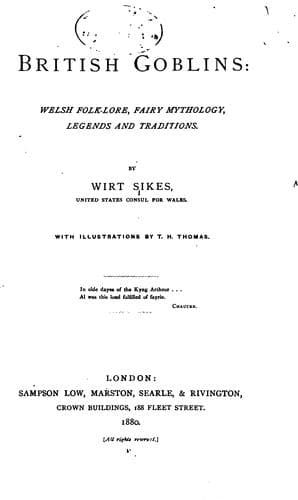
British Goblins: Welsh Folk-lore, Fairy Mythology, Legends and TraditionsSikes, Wirt
History
British Goblins: Welsh Folk-lore, Fairy Mythology, Legends and Traditions
Sikes, Wirt
Folklore -- Wales; Goblins -- Wales; Mythology, Celtic -- Wales; Mythology, Welsh; Wales -- Social life and customs
There were other sports and pastimes common alike to Easter and to the
Sabbath day, which are full of curious interest. Some of them no doubt
arose out of the social exigencies of sparsely settled neighbourhoods,
which caused people to remain at the church between services, instead
of returning to distant homes; but a Druidic origin seems necessary to
account for others. That the people should between services gather
near the church to talk over the gossip of the day, is natural enough,
and is a phenomenon which may still be witnessed in remote parts of
the United States. In St. Dogmell's parish, Pembrokeshire, there is a
tump which bears the name of 'Cnwc y Celwydd,' videlicet, the Tump of
Lies. Here were men and women formerly in the habit of gathering
together on the Lord's day in great crowds, and entertaining each
other with the inventing and telling of the most lying and wonderful
yarns they could conjure up with the aid of an imagination spurred to
exercise by rivalry and applause. The custom is discontinued; but
there is still hardly a neighbourhood in Wales so rich in tales of
fairies and other goblins.
The custom of dancing in churchyards was common in many parts of the
Principality in the early part of this century. At Aberedwy, Malkin
saw a large yew tree in the churchyard under which as many as sixty
couples had been seen dancing at once.[125] The dancing was not in
that part of the yard consecrated to the dead, but on the north side
of the church, where it was not the custom to bury. A tradition is
preserved by Giraldus of a solemn festival dance which took place in
the churchyard at St. Almedha's church, Breconshire, on that saint's
day. The dance was 'led round the churchyard with a song,' and
succeeded by the dancers falling down in a trance, followed by a sort
of religious frenzy. This is believed to have been a Druidical rite,
described on hearsay by Giraldus, and embellished by him with those
pious inventions not uncommon in his day.
One of the customs of Easter, at a comparatively recent period in
Wales, was getting the children up early in the morning to see the sun
dance. This exercise the sun was said to perform at rising on Easter
Day, in honour of the rising of our Lord. The sun was sometimes aided
in this performance by a bowl of clear water, into which the youth
must look to see the orb dance, as it would be dangerous to look
directly on the sun while thus engaged. The religious dance of the
ancient Druids is believed to exist in modern times in a round dance
wherein the figures imitate the motions of the sun and moon. The
ball-playing in church mentioned above was also accompanied by
dancing.
FOOTNOTES:
[124] 'Arch. Camb.' 4 Se., iii., 333.
[125] Malkin's 'South Wales,' 281.
VI.
Public-domain text, read in full here on John Shaqi.
Reviews
Reviews
No reviews yet
Be the first to share your thoughts on this work.
Elsewhere in the archive
Join the Discussion
Join the discussion
Sign in to leave a comment or review.
Sign InorCreate an account