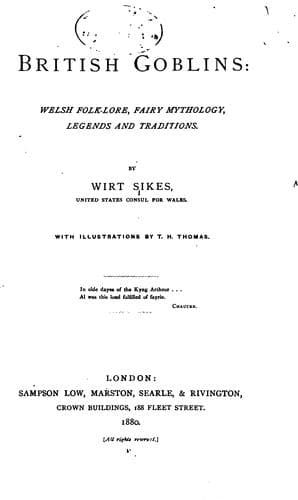
British Goblins: Welsh Folk-lore, Fairy Mythology, Legends and TraditionsSikes, Wirt
History
British Goblins: Welsh Folk-lore, Fairy Mythology, Legends and Traditions
Sikes, Wirt
Folklore -- Wales; Goblins -- Wales; Mythology, Celtic -- Wales; Mythology, Welsh; Wales -- Social life and customs
Midsummer Eve, or St. John's Eve (June 23rd), is one of the ancient
Druidic festivals, still liberally honoured in Wales. The custom of
lighting bonfires survives in some of the villages, and at Pontypridd
there are ceremonies of a solemn sort. Midsummer Eve, in 1878, fell on
a Sunday. Upon that day the 'Druids and bards' at Pontypridd held the
usual feast of the summer solstice in the face of the sun. There is a
breezy common on the top of a high hill overlooking the town, where
stand a logan stone and a circle of upright stones constituting the
'temple of the Druids.' Here it is the custom of the present-day
adherents of that ancient religion, beside which Christianity is an
infant, to celebrate their rites 'within the folds of the serpent,' a
circle marked with the signs of the zodiac. The venerable archdruid,
Myfyr Morganwg, stands on the logan stone, with a mistletoe sprig in
his button-hole, and prays to the god Kali, 'creator of sun, moon,
stars, and universe.' Then the white-bearded old man delivers a
discourse, and new members are initiated into the 'mysteries,'
Occasionally these new members are Americans from over the sea, and
they include both sexes. Large crowds gather to witness the impressive
spectacle--a shadow of the ancient rites when from Belenian heights
flamed high the sacrificial fires. It was a former belief that these
fires protected the lands within their light from the machinations of
sorcery, so that good crops would follow, and that their ashes were
valuable as a medicinal charm.
The Snake-stone is another striking Welsh tradition, associated with
Midsummer eve. At this time of the year there are certain convocations
of snakes, which, hissing sociably together among one another, hiss
forth a mystic bubble, which hardens into the semblance of a glass
ring. The finder of this ring is a lucky man, for all his undertakings
will prosper while he retains it. These rings are called Gleiniau
Nadroedd in Welsh--snake-stones in English. They are supposed to have
been used by the ancient Druids as charms. There is a Welsh saying,
respecting people who lay their heads together in conversation, that
the talkers are 'blowing the gem.'
II.
Public-domain text, read in full here on John Shaqi.
Reviews
Reviews
No reviews yet
Be the first to share your thoughts on this work.
Elsewhere in the archive
Join the Discussion
Join the discussion
Sign in to leave a comment or review.
Sign InorCreate an account