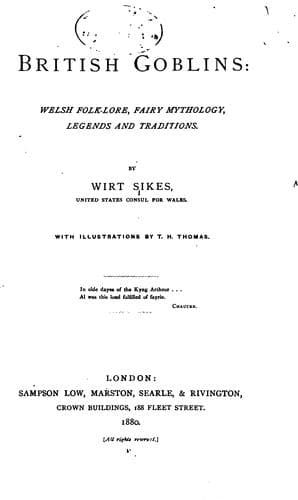
British Goblins: Welsh Folk-lore, Fairy Mythology, Legends and TraditionsSikes, Wirt
History
British Goblins: Welsh Folk-lore, Fairy Mythology, Legends and Traditions
Sikes, Wirt
Folklore -- Wales; Goblins -- Wales; Mythology, Celtic -- Wales; Mythology, Welsh; Wales -- Social life and customs
We come now to the most interesting holiday season of the year, by
reason of its almost universality of observance among Christian
peoples, and the variety of customs peculiar to it. In the land of
Arthur and Merlin it is a season of such earnest and widespread
cordiality, such warm enthusiasm, such hearty congratulations between
man and man, that I have been nowhere equally impressed with the
geniality and joyousness of the time. In some Catholic countries one
sees more merriment on the day itself; indeed, the day itself is not
especially merry in Wales, at least in its out-door aspects. It is the
season rather than the day which is merry in Wales. The festival is
usually understood, throughout Christendom, to include twelve days;
the Welsh people not only make much of the twelve days, but they
extend the peculiar festivities of the season far beyond those limits.
Christmas has fairly begun in Wales a week or two before
Christmas-day. The waits are patrolling the streets of Cardiff as
early as December 5th, and Christmas festivals are held as early as
December 19th, at which Christmas-trees are displayed, and their
boughs denuded of the toys and lollipops in which the juvenile heart
delights. After Christmas-day the festival continues I know not just
how long, but apparently for weeks.
The characteristic diversions of the Christmas season are, in the
main, alike in all Christian countries. In Wales many well-known old
customs are retained which in some other parts of Great Britain have
disappeared, such as the mummers, the waits, carols, bell-ringings,
etc. Not only do the bell-ringers of the several churches throughout
the principality do their handsomest on their own particular bells,
but there are grand gatherings, at special points, of all the
bell-ringers for leagues around, who vie with each other in showing
what feats they can perform, how they can astonish you with their
majors, bob-majors, and triple bob-majors, on the brazen clangers of
the steeples. At Cowbridge, for instance, on Christmas will come
together the ringers from Aberdare, Penarth, St. Fagan's, Llantrisant,
Llanblethian, and other places, thirty or forty in number, and after
they have rung till the air above the town is black with flying clefs
and quavers from the steeples, they will all sit down to a jolly
Christmas-dinner at the Bear. The bands of waits, or 'pipers of the
watch,' who wake the echoes of the early morning with their carols,
are heard in every Welsh town and village. In some towns there are
several bands and much good-natured rivalry. The universal love of
music among the Welsh saves the waits from degenerating into the
woe-begone creatures they are in some parts, where the custom has that
poor degree of life which can be kept in it by shivering clusters of
bawling beggars who cannot sing. Regularly organised and trained
choirs of Welshmen perambulate the Cambrian country, chanting carols
Public-domain text, read in full here on John Shaqi.
Reviews
Reviews
No reviews yet
Be the first to share your thoughts on this work.
Elsewhere in the archive
Join the Discussion
Join the discussion
Sign in to leave a comment or review.
Sign InorCreate an account