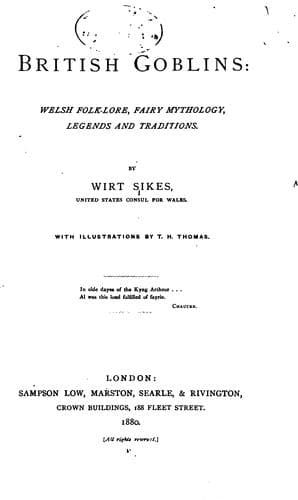
British Goblins: Welsh Folk-lore, Fairy Mythology, Legends and TraditionsSikes, Wirt
History
British Goblins: Welsh Folk-lore, Fairy Mythology, Legends and Traditions
Sikes, Wirt
Folklore -- Wales; Goblins -- Wales; Mythology, Celtic -- Wales; Mythology, Welsh; Wales -- Social life and customs
at Christmas-tide, and bands of musicians play who, in many cases,
would not discredit the finest military orchestras. Carols are sung in
both Welsh and English; and, generally, the waits are popular. If
their music be not good, they are not tolerated; irate gentlemen
attack them savagely and drive them off. Not exactly that boot-jacks
and empty bottles are thrown at them, but they are excoriated in
'letters to the editor,' in which strong language is hurled at them as
intolerable nuisances, ambulatory disturbers of the night's quiet, and
inflicters of suffering upon the innocent. But such cases are rare.
The music is almost invariably good, and the effect of the soft
strains of melodiously-warbled Welsh coming dreamily to one's ears
through the darkness and distance on a winter morning is sweet and
soothing to most ears. Sometimes small boys will pipe their carols
through the key-holes. The songs vary greatly in character, but
usually the religious tone prevails, as in this case:
As I sat on a sunny bank, a sunny bank, a sunny bank,
All on a Christmas morning,
Three ships came sailing by, sailing by, sailing by.
Who do you think was in the ships?
Christ and the Virgin Mary.
Both English and Welsh words are sung. Sometimes a group of young men
and women will be seen dancing about the waits to the measure of their
music, in the hours 'ayont the twal.' In one aspect the Welsh people
may be spoken of as a people whose lives are passed in the indulgence
of their love for music and dancing. The air of Wales seems always
full of music. In the Christmas season there is an unending succession
of concerts and of miscellaneous entertainments of which music forms a
part, while you cannot enter an inn where a few are gathered
together, without the imminent probability that one or more will break
forth in song. By this is not meant a general musical howl, such as is
apt to be evoked from a room full of men of any nationality when
somewhat under the influence of the rosy god, but good set songs, with
good Welsh or English words to them, executed with respect for their
work by the vocalists, and listened to with a like respect by the rest
of the company. When an Englishman is drunk he is belligerent; when a
Frenchman is drunk he is amorous; when an Italian is drunk he is
loquacious; when a Scotchman is drunk he is argumentative; when a
German is drunk he is sleepy; when an American is drunk he brags; and
when a Welshman is drunk he sings. Sometimes he dances; but he does
not do himself credit as a dancer under these circumstances; for when
I speak of dancing I do not refer to those wooden paces and
inflections which pass for dancing in society, and which are little
more than an amiable pretext for bringing in contact human elements
which are slow to mix when planted in chairs about a room: I refer to
Public-domain text, read in full here on John Shaqi.
Reviews
Reviews
No reviews yet
Be the first to share your thoughts on this work.
Elsewhere in the archive
Join the Discussion
Join the discussion
Sign in to leave a comment or review.
Sign InorCreate an account