British Goblins: Welsh Folk-lore, Fairy Mythology, Legends and Traditions — John Shaqi
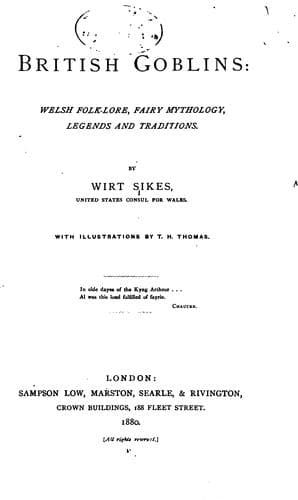
British Goblins: Welsh Folk-lore, Fairy Mythology, Legends and TraditionsSikes, Wirt
History
British Goblins: Welsh Folk-lore, Fairy Mythology, Legends and Traditions
Sikes, Wirt
Folklore -- Wales; Goblins -- Wales; Mythology, Celtic -- Wales; Mythology, Welsh; Wales -- Social life and customs
The resemblance of this tale to many he has encountered will at once
be noted by the student of comparative folk-lore. He will also observe
that it trenches on the domain of another class in my own enumeration,
viz., that of the Bwbach, or household fairy. This is the stone over
which one is constantly stumbling in this field of scientific
research. Mr. Baring-Gould's idea that all household tales are
reducible to a primeval root (in the same or a similar manner that we
trace words to their roots), though most ingeniously illustrated by
him, is constantly involved in trouble of the sort mentioned. He
encounters the obstacle which lies in the path of all who walk this
way. His roots sometimes get inextricably gnarled and intertwisted
with each other. But some effort of this sort is imperative, and we
must do the best we can with our materials. Stories of the class of
Grimm's Witchelmänner (Kinder und Hausmärchen) will be recalled by the
legend of Rowli Pugh as here told. The German Hausmänner are elves of
a domestic turn, sometimes mischievous and sometimes useful, but
usually looking for some material reward for their labours. So with
the English goblin named by Milton in 'L'Allegro,' which drudges,
To earn his cream-bowl duly set.
FOOTNOTE:
[12] Until recently, Welsh women retained their maiden names even
after marriage.
IV.
The Ellylldan is a species of elf exactly corresponding to the English
Will-o'-wisp, the Scandinavian Lyktgubhe, and the Breton Sand Yan y
Tad. The Welsh word dan means fire; dan also means a lure; the
compound word suggests a luring elf-fire. The Breton Sand Yan y Tad
(St. John and Father)[13] is a double ignis fatuus fairy, carrying at
its finger-ends five lights, which spin round like a wheel. The
negroes of the southern seaboard states of America invest this goblin
with an exaggeration of the horrible peculiarly their own. They call
it Jack-muh-lantern, and describe it as a hideous creature five feet
in height, with goggle-eyes and huge mouth, its body covered with long
hair, and which goes leaping and bounding through the air like a
gigantic grasshopper. This frightful apparition is stronger than any
man, and swifter than any horse, and compels its victims to follow it
into the swamp, where it leaves them to die.
Like all goblins of this class, the Ellylldan was, of course, seen
dancing about in marshy grounds, into which it led the belated
wanderer; but, as a distinguished resident in Wales has wittily said,
the poor elf 'is now starved to death, and his breath is taken from
him; his light is quenched for ever by the improving farmer, who has
drained the bog; and, instead of the rank decaying vegetation of the
autumn, where bitterns and snipes delighted to secrete themselves,
crops of corn and potatoes are grown.'[14]
Public-domain text, read in full here on John Shaqi.
Reviews
Reviews
No reviews yet
Be the first to share your thoughts on this work.
Join the Discussion
Join the discussion
Sign in to leave a comment or review.
Sign InorCreate an account