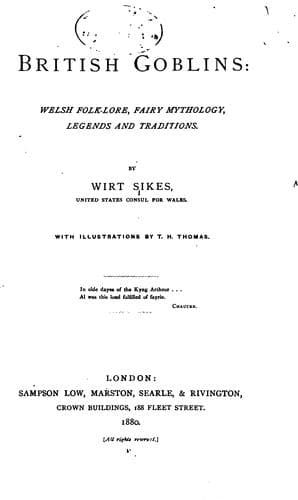
British Goblins: Welsh Folk-lore, Fairy Mythology, Legends and TraditionsSikes, Wirt
History
British Goblins: Welsh Folk-lore, Fairy Mythology, Legends and Traditions
Sikes, Wirt
Folklore -- Wales; Goblins -- Wales; Mythology, Celtic -- Wales; Mythology, Welsh; Wales -- Social life and customs
religion spoils one day out of seven, destroys the seventh part of
possible happiness, would find strong illustration in Wales. It is not
my purpose to argue whether the illustration would prove or disprove
Stendhal's assertion, though one might fairly ask whether religious
people are not, perhaps, as happy in going to church on Sunday as
irreligious people are in staying away.
II.
Let it not be supposed that there is any lack of amusement on
Christmas-day for people who are willing to be amused in a God-fearing
manner. Although you cannot go to the theatre or the circus, you can
have a wide liberty of choice among oratorios, concerts, examinations,
exhibitions, eisteddfodau, and other odd diversions. Concerts
especially thrive. The halls in which they are held are decorated with
evergreens, and the familiar custom is in Wales habitually and
commonly associated with the ancient Druids, who viewed the green
twigs as the symbols of perennial life. Thus a peculiar poetic grace
rests with a custom beautiful in itself, and capable in any land of
being poetized by any one poetically inclined. Many of those unique
gatherings called eisteddfodau are held in different parts of the
principality, when poetry, music, and essays, in Welsh and in English,
are put forth by the strivers in these Olympian games of intellect and
culture, after the prizes which in Hellas would have given them crowns
of olive-leaves instead of gold-coins of the realm. When Pindar and
Sophocles handed in poems, and Herodotus competed among the essayists,
and Phidias and Praxiteles among the cutters of stone, there was no
Christmas,--but it is claimed there were eisteddfodau, here in Wales;
ay, and before that; for has not Herodotus spoken of the British bards
who held them?
III.
Public-domain text, read in full here on John Shaqi.
Reviews
Reviews
No reviews yet
Be the first to share your thoughts on this work.
Elsewhere in the archive
Join the Discussion
Join the discussion
Sign in to leave a comment or review.
Sign InorCreate an account