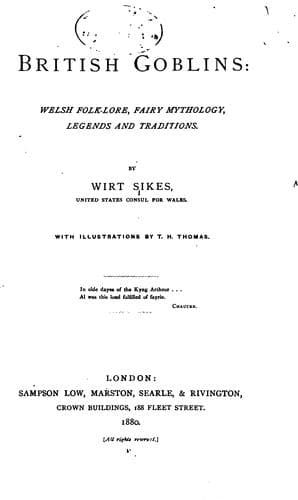
British Goblins: Welsh Folk-lore, Fairy Mythology, Legends and TraditionsSikes, Wirt
History
British Goblins: Welsh Folk-lore, Fairy Mythology, Legends and Traditions
Sikes, Wirt
Folklore -- Wales; Goblins -- Wales; Mythology, Celtic -- Wales; Mythology, Welsh; Wales -- Social life and customs
The words are certainly modern, and as certainly not of a high order
of literary merit, but they are extremely characteristic of life at
this season in Wales, where kissing under the mistletoe is a custom
still honoured by observance. There was dancing, too, in this inn
company--performed with stern and determined purpose to excel, by
individuals who could do a jig, and wished to do it well. The harper
played a wild lilting tune; a serious individual who looked like a
school-teacher took off his hat, bowed to the company, jumped into the
middle of the floor, and began to dance like a madman. It was a
strange sight. With a face whose grave earnestness relaxed no whit,
with firmly compressed lips and knitted brow, the serious person
shuffled and double-shuffled, and swung and teetered, and flailed the
floor with his rattling soles, till the perspiration poured in
rivulets down his solemn face. The company was greatly moved;
enthusiastic ejaculations in Welsh and English were heard; shouts of
approbation and encouragement arose; and still the serious person
danced and danced, ending at last with a wonderful pigeon-wing, and
taking his seat exhausted, amid a tremendous roar of applause.
Scenes like this are common throughout Wales at the Christmas-time;
and they contrast strangely with the austerities of religious
observance which are everywhere proceeding. But there is not so wide a
chasm between the two as would exist in some countries. The best
church-members frequently do not deem a little jollity of this sort a
hanging matter, and there are ministers who can do a double-shuffle
themselves if the worst comes to the worst. A worthy pastor in
Glamorganshire related to me, with a suspicious degree of relish, a
story about two ministers who were once riding through a certain
village of Wales on horseback. One was the Rev. Evan Harris, the other
a celebrated old preacher named Shenkin Harry. And, as they rode on,
Harris noticed his companion's legs twitching curiously on his horse's
sides. 'Why, what ails your leg?' he asked. 'Don't you hear the harp,'
was the reply, 'in the public-house yonder? It makes my old toes crazy
for a jig.' But the moral tone of Wales is certainly better, on the
whole, than that of most countries--better even than that of Great
Britain generally, I should say. There is, I know, a prevailing
impression quite to the contrary; but it is utterly absurd. It is an
impression which has grown, I imagine, out of English injustice to
Welshmen in former times, allied to English ignorance in those times
concerning this people. Until within the last hundred years, English
writers habitually wrote of Wales with contempt and even scurrility.
But no one can live in Wales and not form the opinion that the Welsh
are, in truth, an exceptionally moral people; and the nature of their
public entertainments throughout the Christmas-time enforces this
conclusion. Stendhal's declaration that, in true Biblical countries,
Public-domain text, read in full here on John Shaqi.
Reviews
Reviews
No reviews yet
Be the first to share your thoughts on this work.
Elsewhere in the archive
Join the Discussion
Join the discussion
Sign in to leave a comment or review.
Sign InorCreate an account