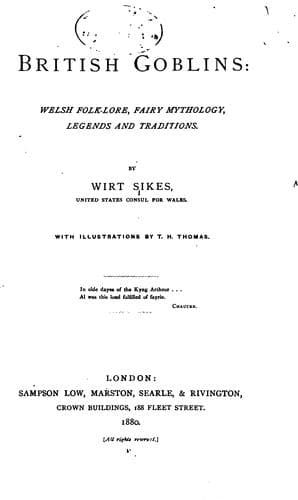
British Goblins: Welsh Folk-lore, Fairy Mythology, Legends and TraditionsSikes, Wirt
History
British Goblins: Welsh Folk-lore, Fairy Mythology, Legends and Traditions
Sikes, Wirt
Folklore -- Wales; Goblins -- Wales; Mythology, Celtic -- Wales; Mythology, Welsh; Wales -- Social life and customs
Welsh courtship is a thorough-going business, early entered upon by
the boys and girls of the Principality; and consequently most Welsh
women marry young. The ancient laws of Howell the Good (died 948)
expressly provided that a woman should be considered marriageable from
fourteen upwards, and should be entitled to maintenance from that age
until the end of her fortieth year; 'that is to say, from fourteen to
forty she ought to be considered in her youth.' By every sort of moral
suasion it is deemed right in Wales to encourage matrimony, and no
where are old bachelors viewed with less forbearance. There used to be
a custom--I know not whether it be extinct now--of expressing the
popular disapprobation for celibacy by planting on the graves of old
bachelors that ill-scented plant, the rue, and sometimes thistles,
nettles, henbane, and other unlovely weeds. The practice was even
extended, most illiberally and unjustly, to the graves of old maids,
who certainly needed no such insult added to their injury. Probably
the custom was never very general, but grew out of similar--but
other-meaning--customs which are still prevalent, and which are very
beautiful. I refer to the planting of graves with significant flowers
in token of the virtues of the dead. Thus where the red rose is
planted on a grave, its tenant is indicated as having been in life a
person of peculiar benevolence of character. The flower specially
planted on the grave of a young virgin is the white rose. There is
also an old custom, at the funeral of a young unmarried person, of
strewing the way to the grave with evergreens and sweet-scented
flowers, and the common saying in connection therewith is that the
dead one is going to his or her marriage-bed. Sad extremely, and
touchingly beautiful, are these customs; but wherever such exist,
there are sure to be ill-conditioned persons who will vent spiteful
feelings by similar means. Hence the occasional affront to the remains
of antiquated single folk, who had been perhaps of a temperament which
rendered them unpopular.
The Welsh being generally of an affectionate disposition, courtship,
as I have said, is a thorough-going business. To any but a people of
the strongest moral and religious tendencies, some of their customs
would prove dangerous in the extreme; but no people so link love and
religion. More of their courting is done while going home from church
than at any other time whatever; and the Welsh Venus is a holy saint,
and not at all a wicked Pagan character like her classic prototype.
'Holy Dwynwen, goddess of love, daughter of Brychan,' had a church
dedicated to her in Anglesea in 590; and for ages her shrine was
resorted to by desponding swains and lovesick maidens. Her
name--_Dwyn_, to carry off, and _wen_, white--signifies the bearer off
of the palm of fairness; and, ruling the court of love while living,
when dead
A thousand bleeding hearts her power invoked.
Public-domain text, read in full here on John Shaqi.
Reviews
Reviews
No reviews yet
Be the first to share your thoughts on this work.
Elsewhere in the archive
Join the Discussion
Join the discussion
Sign in to leave a comment or review.
Sign InorCreate an account