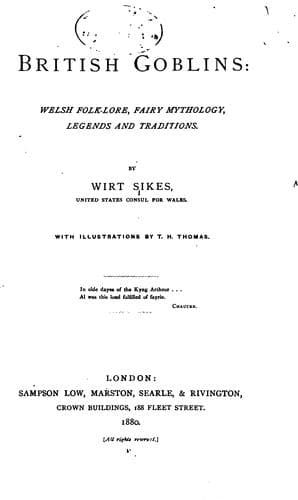
British Goblins: Welsh Folk-lore, Fairy Mythology, Legends and TraditionsSikes, Wirt
History
British Goblins: Welsh Folk-lore, Fairy Mythology, Legends and Traditions
Sikes, Wirt
Folklore -- Wales; Goblins -- Wales; Mythology, Celtic -- Wales; Mythology, Welsh; Wales -- Social life and customs
A curious rhamanta among farm-women is thus described by a learned
Welsh writer:[136] The maiden would get hold of a pullet's first egg,
cut it through the middle, fill one half-shell with wheaten flour and
the other with salt, and make a cake out of the egg, the flour, and
the salt. One half of this she would eat; the other half was put in
the foot of her left stocking under her pillow that night; and after
offering up a suitable prayer, she would go to sleep. What with her
romantic thoughts, and her thirst after eating this salty cake, it was
not perhaps surprising that the future husband should be seen, in a
vision of the night, to come to the bedside bearing a vessel of water
or other beverage for the thirsty maid. Another custom was to go into
the garden at midnight, in the season when 'black seed' was sown, and
sow leeks, with two garden rakes. One rake was left on the ground
while the young woman worked away with the other, humming to herself
the while,
Y sawl sydd i gydfydio,
Doed i gydgribinio!
Or in English:
He that would a life partner be,
Let him also rake with me.
There was a certain young Welshwoman who, about eighty years ago,
performed this rhamanta, when who should come into the garden but her
master! The lass ran to the house in great fright, and asked her
mistress, 'Why have you sent master out into the garden to me?' 'Wel,
wel,' replied the good dame, in much heaviness of heart, 'make much of
my little children!' The mistress died shortly after, and the husband
eventually married the servant.
The sterner sex have a form of rhamanta in which the knife plays a
part. This is to enter the churchyard at midnight, carrying a twca,
which is a sort of knife made out of an old razor, with a handle of
sheep or goat-horn, and encircle the church edifice seven times,
holding the twca at arm's length, and saying, 'Dyma'r twca, p'le mae'r
wain?' (Here's the twca--where's the sheath?)
FOOTNOTE:
[136] Cynddelw, 'Manion Hynafiaethol,' 53.
CHAPTER VI.
Wedding Customs--The Bidding--Forms of Cymmhorth--The
Gwahoddwr--Horse-Weddings--Stealing a Bride--Obstructions to
the Bridal Party--The Gwyntyn--Chaining--Evergreen
Arches--Strewing Flowers--Throwing Rice and Shoes--Rosemary
in the Garden--Names after Marriage--The Coolstrin--The
Ceffyl Pren.
I.
Public-domain text, read in full here on John Shaqi.
Reviews
Reviews
No reviews yet
Be the first to share your thoughts on this work.
Elsewhere in the archive
Join the Discussion
Join the discussion
Sign in to leave a comment or review.
Sign InorCreate an account