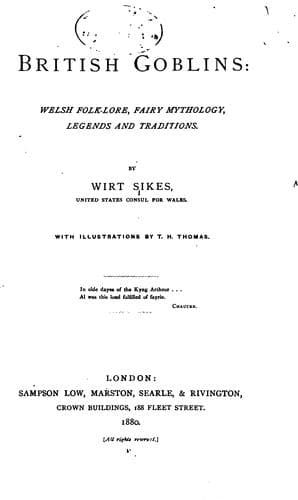
British Goblins: Welsh Folk-lore, Fairy Mythology, Legends and TraditionsSikes, Wirt
History
British Goblins: Welsh Folk-lore, Fairy Mythology, Legends and Traditions
Sikes, Wirt
Folklore -- Wales; Goblins -- Wales; Mythology, Celtic -- Wales; Mythology, Welsh; Wales -- Social life and customs
Wales retains several ancient customs in connection with weddings,
which are elsewhere extinct. No one who has ever paid any attention to
Wales and its ways can have failed to hear of that most celebrated
rite the Bidding, which is, however, one of several picturesque
survivals less well known to the outer world. The Bidding wedding must
be spoken of as an existing custom, although it be confined to rural
neighbourhoods in South Wales, and to obscure and humble folk. Those
who strive to prove that all such customs are obsolete everywhere--a
thankless and even ungraceful task, it seems to me--will not admit
that the Bidding has been known since 1870. I have evidence, however,
that in Pembroke, Cardigan, and Carmarthen shires, the custom did not
cease on the date named, and there is every probability that it
prevails to-day. Nothing could be of smaller importance, it is true,
than the precise date on which a given custom recently ceased, since
any one may revive it next year who chooses to do so.
The Bidding is an invitation sent by a couple who are about to be
married, soliciting the presence and donations of the neighbours on
their behalf. The presents may be either sums of money or
necessaries. Gifts of bread, butter, cheese, tea, sugar, and the like,
are common, and sometimes articles of farming stock and household
furniture. All gifts of money are recognized by a sort of promissory
note, i.e., by setting down the name and residence of the donor, with
the amount given; and when a like occasion arises on the part of the
giver, the debt is religiously paid. The obligation is an absolute
one, and its legality has actually been recognized by the Court of
Great Sessions at Cardiff. The gift is even claimable under other
circumstances than the donor's getting married. Another sort of
contribution is the eatables and drinkables which are set before the
guests; these are only repayable when required on a like occasion.
The method of bidding the guests was until lately through a personage
called the gwahoddwr (inviter or bidder) who tramped about the country
some days beforehand, proclaiming the particulars to everybody he met.
He usually recited a doggerel set of rhymes before and after the
special invitation--a composition of his own, or understood to be
such, for rhyme-making was a part of the talent of a popular bidder.
Frequently no little humour was displayed in the bidding song. But
since the printing press became the cheap and ready servant of the
humblest classes, the occupation of the bidder has gradually fallen to
decay; a printed circular serves in his place. At the shop of a
printer in Carmarthen I procured a copy of the following bidding
circular, which may be a real document, or a fictitious one:
CARMARTHENSHIRE, JULY 4TH, 1862.
Public-domain text, read in full here on John Shaqi.
Reviews
Reviews
No reviews yet
Be the first to share your thoughts on this work.
Elsewhere in the archive
Join the Discussion
Join the discussion
Sign in to leave a comment or review.
Sign InorCreate an account