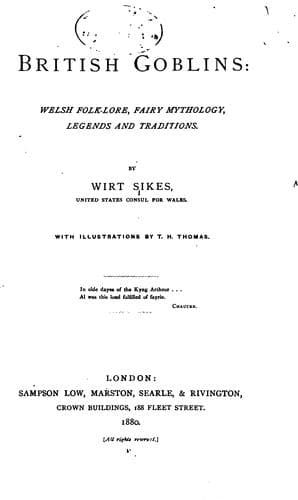
British Goblins: Welsh Folk-lore, Fairy Mythology, Legends and TraditionsSikes, Wirt
History
British Goblins: Welsh Folk-lore, Fairy Mythology, Legends and Traditions
Sikes, Wirt
Folklore -- Wales; Goblins -- Wales; Mythology, Celtic -- Wales; Mythology, Welsh; Wales -- Social life and customs
The Bidding is but one form of a feature of Welsh life which
extensively prevails, known by the term Cymmhorth. The Bidding is a
Priodas Cymmhorth; the Cyfarfod Cymmhorth, or Assistance Meeting, is
much the same thing, minus the wedding feature. The customs of the
latter festival are, however, often of a sort distinctly tending
toward matrimonial results as an eventuality. A number of farmer girls
of the humbler sort will gather at a stated time and place to give a
day's work to one needing assistance, and after a day spent in such
toil as may be required, the festival winds up with jollity in the
evening. The day is signalized on the part of those youths of the
neighbourhood who are interested in the girls, by tokens of that
interest in the shape of gifts. The lass who receives a gift
accompanied by a twig of birch is thereby assured of her lover's
constancy. To her whom the young man would inform of his change of
heart, a sprig of hazel is given. An earlier feature of this ceremony
was the Merry Andrew, who presented the gifts in the name of the
lover. This personage was disguised fantastically, and would lead the
young woman he selected into another room, where he would deliver the
gift and whisper the giver's name.
The antiquity of the Bidding as a local custom is undoubted. The
old-time gwahoddwr was a person of much importance, skilled in
pedigrees and family traditions, and himself of good family. A
chieftain would assume the character in behalf of his vassal, and
hostile clans respected his person as he went about from castle to
castle, from hall to hall. He bore a garlanded staff as the emblem of
his office, and on entering a dwelling would strike his staff upon the
floor to command the attention of the group before him, and then begin
his address.
II.
Public-domain text, read in full here on John Shaqi.
Reviews
Reviews
No reviews yet
Be the first to share your thoughts on this work.
Elsewhere in the archive
Join the Discussion
Join the discussion
Sign in to leave a comment or review.
Sign InorCreate an account