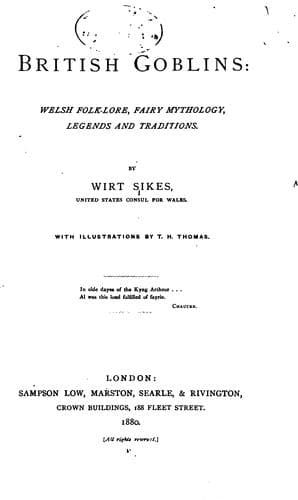
British Goblins: Welsh Folk-lore, Fairy Mythology, Legends and TraditionsSikes, Wirt
History
British Goblins: Welsh Folk-lore, Fairy Mythology, Legends and Traditions
Sikes, Wirt
Folklore -- Wales; Goblins -- Wales; Mythology, Celtic -- Wales; Mythology, Welsh; Wales -- Social life and customs
Gwrando, leidr hoyw'r ddafad,
Ai ti sydd yma heddyw'n geidwad?
Ai dyna y rheswm cloi y drysau,
Rhag dwyn y wreigan liw dydd goleu?
(Ah, sheep-stealer, art thou a guardian of the fair one? If
the doors were not locked thou wouldst steal the bride in
broad daylight.)
The doors are opened in the end, of course, and after refreshments the
wedding party gallops off to church. The bride is stolen away and
borne off to a distance on her captor's horse, but only in sport; her
captor brings her back to the church, where she is quietly married to
the proper person. Sometimes the precaution is taken of celebrating
the marriage privately at an early hour, and the racing takes place
afterward.
Obstructions are raised by the bride's friends, to prevent the
bridegroom's party from coming to her house, and these difficulties
must be overcome ere the bride can be approached. Sometimes a mock
battle on the road is a feature of the racing to church. The
obstructions placed in the road in former days included the Gwyntyn, a
sort of game of skill which seems to have been used by most nations in
Europe, called in English the quintain. It was an upright post, upon
which a cross-piece turned freely, at one end of which hung a
sand-bag, the other end presenting a flat side. At this the rider
tilted with his lance, his aim being to pass without being hit in the
rear by the sand-bag. Other obstructions in use are ropes of straw and
the like.
There is a Welsh custom called Chaining, which probably arose out of
the horse-wedding, and still prevails. In the village of Sketty,
Glamorganshire, in August, 1877, I saw a chaining, on the occasion of
a marriage between an old lady of eighty and a man of fifty. The
affair had made so much talk, owing to the age of the bride, that the
whole village was in the streets. While the wedding ceremony was in
progress, a chain was stretched across the street, forming a barrier
which the wedding party could not pass till the chainers were
'tipped.' The driver of the carriage containing the newly wedded pair
was an Englishman, and ignorant of the custom, at which he was
naturally indignant. His angry efforts to drive through the barrier
made great sport for the Welshmen.
The origin of the Welsh horse-wedding may be traced to the Romans, if
no further back, and may thus be connected with the rape of the
Sabines. That the Romans had an exactly similar custom is attested by
Apuleius, and it is said to have been established by Romulus in memory
of the Sabine virgins. It is not improbable that the Romans may have
left the custom behind them when they quitted this territory in the
fifth century, after nearly three hundred years' rule.
FOOTNOTE:
[137] Malkin's 'South Wales,' 67.
III.
Public-domain text, read in full here on John Shaqi.
Reviews
Reviews
No reviews yet
Be the first to share your thoughts on this work.
Elsewhere in the archive
Join the Discussion
Join the discussion
Sign in to leave a comment or review.
Sign InorCreate an account