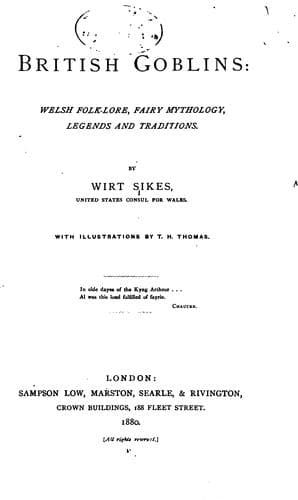
British Goblins: Welsh Folk-lore, Fairy Mythology, Legends and TraditionsSikes, Wirt
History
British Goblins: Welsh Folk-lore, Fairy Mythology, Legends and Traditions
Sikes, Wirt
Folklore -- Wales; Goblins -- Wales; Mythology, Celtic -- Wales; Mythology, Welsh; Wales -- Social life and customs
A servant girl who attended to the cattle on the Trwyn farm, near
Abergwyddon, used to take food to 'Master Pwca,' as she called the
elf. A bowl of fresh milk and a slice of white bread were the
component parts of the goblin's repast, and were placed on a certain
spot where he got them. One night the girl, moved by the spirit of
mischief, drank the milk and ate most of the bread, leaving for Master
Pwca only water and crusts. Next morning she found that the fastidious
fairy had left the food untouched. Not long after, as the girl was
passing the lonely spot, where she had hitherto left Pwca his food,
she was seized under the arm pits by fleshly hands (which, however,
she could not see), and subjected to a castigation of a most
mortifying character. Simultaneously there fell upon her ear in good
set Welsh a warning not to repeat her offence on peril of still worse
treatment. This story 'is thoroughly believed in there to this
day.'[18]
I visited the scene of the story, a farm near Abergwyddon (now called
Abercarne), and heard a great deal more of the exploits of that
particular Pwca, to which I will refer again. The most singular fact
of the matter is that although at least a century has elapsed, and
some say several centuries, since the exploits in question, you cannot
find a Welsh peasant in the parish but knows all about Pwca'r Trwyn.
FOOTNOTES:
[16] According to a letter written by the poet Campbell to Mrs.
Fletcher, in 1833, and published in her Autobiography, it was thought
Shakspeare went in person to see this magic valley. 'It is no later than
yesterday,' wrote Campbell, 'that I discovered a probability--almost
near a certainty--that Shakspeare visited friends in the very town
(Brecon in Wales) where Mrs. Siddons was born, and that he there found
in a neighbouring glen, called "The Valley of Fairy Puck," the principal
machinery of his "Midsummer Night's Dream."'
[17] 'Midsummer Night's Dream,' Act III., Sc. 3.
[18] 'Archæologia Cambrensis,' 4th Se., vi., 175. (1875.)
VI.
The most familiar form of the Pwca story is one which I have
encountered in several localities, varying so little in its details
that each account would be interchangeable with another by the
alteration of local names. This form presents a peasant who is
returning home from his work, or from a fair, when he sees a light
travelling before him. Looking closer he perceives that it is carried
by a dusky little figure, holding a lantern or candle at arm's length
over its head. He follows it for several miles, and suddenly finds
himself on the brink of a frightful precipice. From far down below
there rises to his ears the sound of a foaming torrent. At the same
moment the little goblin with the lantern springs across the chasm,
alighting on the opposite side; raises the light again high over its
head, utters a loud and malicious laugh, blows out its candle and
disappears up the opposite hill, leaving the awestruck peasant to get
home as best he can.
Public-domain text, read in full here on John Shaqi.
Reviews
Reviews
No reviews yet
Be the first to share your thoughts on this work.
Join the Discussion
Join the discussion
Sign in to leave a comment or review.
Sign InorCreate an account