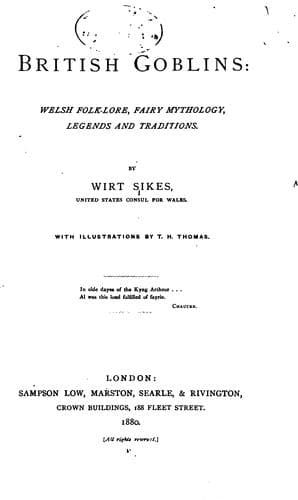
British Goblins: Welsh Folk-lore, Fairy Mythology, Legends and TraditionsSikes, Wirt
History
British Goblins: Welsh Folk-lore, Fairy Mythology, Legends and Traditions
Sikes, Wirt
Folklore -- Wales; Goblins -- Wales; Mythology, Celtic -- Wales; Mythology, Welsh; Wales -- Social life and customs
quoted in this instance as being more significant than individual cases
would be. Of these last I have encountered many. Yet I should be sorry
if any reader were to conclude from all this that Welsh miners are not
in the main intelligent, church-going, newspaper-reading men. They are
so, I think, even beyond the common. Their superstitions, therefore,
like those of the rest of us, must be judged as 'a thing apart,' not to
be reconciled with intelligence and education, but co-existing with
them. Absolute freedom from superstition can come only with a degree of
scientific culture not yet reached by mortal man.
It can hardly be cause for wonder that the miner should be
superstitious. His life is passed in a dark and gloomy region, fathoms
below the earth's green surface, surrounded by walls on which dim
lamps shed a fitful light. It is not surprising that imagination (and
the Welsh imagination is peculiarly vivid) should conjure up the faces
and forms of gnomes and coblynau, of phantoms and fairy men. When they
hear the mysterious thumping which they know is not produced by any
human being, and when in examining the place where the noise was heard
they find there are really valuable indications of ore, the sturdiest
incredulity must sometimes be shaken. Science points out that the
noise may be produced by the action of water upon the loose stones in
fissures and pot-holes of the mountain limestone, and does actually
suggest the presence of metals.
In the days before a Priestley had caught and bottled that demon which
exists in the shape of carbonic acid gas, when the miner was smitten
dead by an invisible foe in the deep bowels of the earth it was
natural his awestruck companions should ascribe the mysterious blow to
a supernatural enemy. When the workman was assailed suddenly by what
we now call fire-damp, which hurled him and his companions right and
left upon the dark rocks, scorching, burning, and killing, those who
survived were not likely to question the existence of the mine fiend.
Hence arose the superstition--now probably quite extinct--of basilisks
in the mines, which destroyed with their terrible gaze. When the
explanation came, that the thing which killed the miner was what he
breathed, not what he saw; and when chemistry took the fire-damp from
the domain of faerie, the basilisk and the fire fiend had not a leg to
stand on. The explanation of the Knockers is more recent, and less
palpable and convincing.
IX.
Public-domain text, read in full here on John Shaqi.
Reviews
Reviews
No reviews yet
Be the first to share your thoughts on this work.
Join the Discussion
Join the discussion
Sign in to leave a comment or review.
Sign InorCreate an account