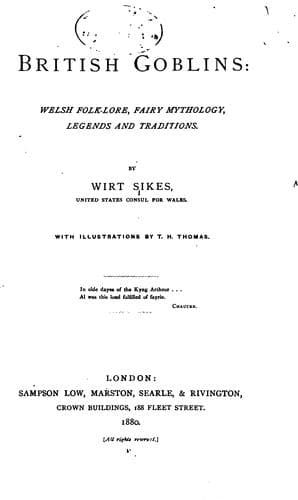
British Goblins: Welsh Folk-lore, Fairy Mythology, Legends and TraditionsSikes, Wirt
History
British Goblins: Welsh Folk-lore, Fairy Mythology, Legends and Traditions
Sikes, Wirt
Folklore -- Wales; Goblins -- Wales; Mythology, Celtic -- Wales; Mythology, Welsh; Wales -- Social life and customs
The counterparts of the Coblynau are found in most mining countries.
In Germany, the Wichtlein (little Wights) are little old long-bearded
men, about three-quarters of an ell high, which haunt the mines of the
southern land. The Bohemians call the Wichtlein by the name of
Haus-schmiedlein, little House-smiths, from their sometimes making a
noise as if labouring hard at the anvil. They are not so popular as in
Wales, however, as they predict misfortune or death. They announce the
doom of a miner by knocking three times distinctly, and when any
lesser evil is about to befall him they are heard digging, pounding,
and imitating other kinds of work. In Germany also the kobolds are
rather troublesome than otherwise, to the miners, taking pleasure in
frustrating their objects, and rendering their toil unfruitful.
Sometimes they are downright malignant, especially if neglected or
insulted, but sometimes also they are indulgent to individuals whom
they take under their protection. 'When a miner therefore hit upon a
rich vein of ore, the inference commonly was not that he possessed
more skill, industry, or even luck than his fellow-workmen, but that
the spirits of the mine had directed him to the treasure.'[20]
The intimate connection between mine fairies and the whole race of
dwarfs is constantly met throughout the fairy mythology; and the
connection of the dwarfs with the mountains is equally universal.
'God,' says the preface to the Heldenbuch, 'gave the dwarfs being,
because the land and the mountains were altogether waste and
uncultivated, and there was much store of silver and gold and precious
stones and pearls still in the mountains.' From the most ancient
times, and in the oldest countries, down to our own time and the new
world of America, the traditions are the same. The old Norse belief
which made the dwarfs the current machinery of the northern Sagas is
echoed in the Catskill Mountains with the rolling of the thunder among
the crags where Hendrik Hudson's dwarfs are playing ninepins.
FOOTNOTE:
[20] Scott, 'Demonology and Witchcraft,' 121.
XI.
The Bwbach, or Boobach, is the good-natured goblin which does good
turns for the tidy Welsh maid who wins its favour by a certain course
of behaviour recommended by long tradition. The maid having swept the
kitchen, makes a good fire the last thing at night, and having put the
churn, filled with cream, on the whitened hearth, with a basin of
fresh cream for the Bwbach on the hob, goes to bed to await the event.
In the morning she finds (if she is in luck) that the Bwbach has
emptied the basin of cream, and plied the churn-dasher so well that
the maid has but to give a thump or two to bring the butter in a great
lump. Like the Ellyll which it so much resembles, the Bwbach does not
approve of dissenters and their ways, and especially strong is its
aversion to total abstainers.
Public-domain text, read in full here on John Shaqi.
Reviews
Reviews
No reviews yet
Be the first to share your thoughts on this work.
Join the Discussion
Join the discussion
Sign in to leave a comment or review.
Sign InorCreate an account