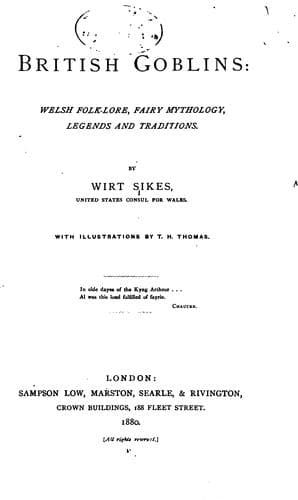
British Goblins: Welsh Folk-lore, Fairy Mythology, Legends and TraditionsSikes, Wirt
History
British Goblins: Welsh Folk-lore, Fairy Mythology, Legends and Traditions
Sikes, Wirt
Folklore -- Wales; Goblins -- Wales; Mythology, Celtic -- Wales; Mythology, Welsh; Wales -- Social life and customs
This legend appears, in a slightly different form, in the 'Iolo MSS.,'
as translated by Taliesin Williams, of Merthyr:[25] 'The milk-white
milch cow gave enough of milk to every one who desired it; and however
frequently milked, or by whatever number of persons, she was never
found deficient. All persons who drank of her milk were healed of
every illness; from fools they became wise; and from being wicked,
became happy. This cow went round the world; and wherever she
appeared, she filled with milk all the vessels that could be found,
leaving calves behind her for all the wise and happy. It was from her
that all the milch cows in the world were obtained. After traversing
through the island of Britain, for the benefit and blessing of country
and kindred, she reached the Vale of Towy; where, tempted by her fine
appearance and superior condition, the natives sought to kill and eat
her; but just as they were proceeding to effect their purpose, she
vanished from between their hands, and was never seen again. A house
still remains in the locality, called Y Fuwch Laethwen Lefrith (The
Milk-white Milch Cow.)'
FOOTNOTE:
[25] Llandovery, published for the Welsh MSS. Society, 1848.
IV.
The legend of the Meddygon Myddfai again introduces the elfin cattle
to our notice, but combines with them another and a very interesting
form of this superstition, namely, that of the wife of supernatural
race. A further feature gives it its name, Meddygon meaning
physicians, and the legend professing to give the origin of certain
doctors who were renowned in the thirteenth century. The legend
relates that a farmer in the parish of Myddfai, Carmarthenshire,
having bought some lambs in a neighbouring fair, led them to graze
near Llyn y Fan Fach, on the Black Mountains. Whenever he visited
these lambs three beautiful damsels appeared to him from the lake, on
whose shores they often made excursions. Sometimes he pursued and
tried to catch them, but always failed; the enchanting nymphs ran
before him and on reaching the lake taunted him in these words:
Cras dy fara,
Anhawdd ein dala;
which, if one must render it literally, means:
Bake your bread,
'Twill be hard to catch us;
but which, more poetically treated, might signify:
Mortal, who eatest baken bread,
Not for thee is the fairy's bed!
Public-domain text, read in full here on John Shaqi.
Reviews
Reviews
No reviews yet
Be the first to share your thoughts on this work.
Join the Discussion
Join the discussion
Sign in to leave a comment or review.
Sign InorCreate an account