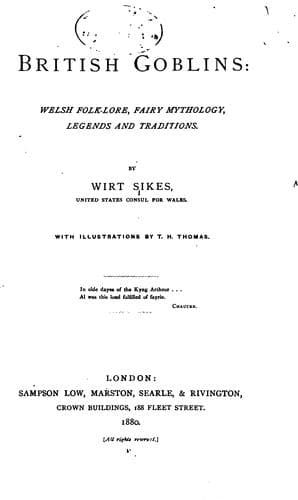
British Goblins: Welsh Folk-lore, Fairy Mythology, Legends and TraditionsSikes, Wirt
History
British Goblins: Welsh Folk-lore, Fairy Mythology, Legends and Traditions
Sikes, Wirt
Folklore -- Wales; Goblins -- Wales; Mythology, Celtic -- Wales; Mythology, Welsh; Wales -- Social life and customs
In a more polished and elaborate form this legend omits the medical
features altogether, but substitutes a number of details so peculiarly
Welsh that I cannot refrain from presenting them. This version
relates that the enamoured farmer had heard of the lake maiden, who
rowed up and down the lake in a golden boat, with a golden oar. Her
hair was long and yellow, and her face was pale and melancholy. In his
desire to see this wondrous beauty, the farmer went on New Year's Eve
to the edge of the lake, and in silence awaited the coming of the
first hour of the new year. It came, and there in truth was the maiden
in her golden boat, rowing softly to and fro. Fascinated, he stood for
hours beholding her, until the stars faded out of the sky, the moon
sank behind the rocks, and the cold gray dawn drew nigh; and then the
lovely gwraig began to vanish from his sight. Wild with passion, and
with the thought of losing her for ever, he cried aloud to the
retreating vision, 'Stay! stay! Be my wife.' But the gwraig only
uttered a faint cry, and was gone. Night after night the young farmer
haunted the shores of the lake, but the gwraig returned no more. He
became negligent of his person; his once robust form grew thin and
wan; his face was a map of melancholy and despair. He went one day to
consult a soothsayer who dwelt on the mountain, and this grave
personage advised him to besiege the damsel's heart with gifts of
bread and cheese. This counsel commending itself strongly to his Welsh
way of thinking, the farmer set out upon an assiduous course of
casting his bread upon the waters--accompanied by cheese. He began on
Midsummer eve by going to the lake and dropping therein a large cheese
and a loaf of bread. Night after night he continued to throw in loaves
and cheeses, but nothing appeared in answer to his sacrifices. His
hopes were set, however, on the approaching New Year's eve. The
momentous night arrived at last. Clad in his best array, and armed
with seven white loaves and his biggest and handsomest cheese, he set
out once more for the lake. There he waited till midnight, and then
slowly and solemnly dropped the seven loaves into the water, and with
a sigh sent the cheese to keep them company. His persistence was at
length rewarded. The magic skiff appeared; the fair gwraig guided it
to where he stood; stepped ashore, and accepted him as her husband.
The before-mentioned stipulation was made as to the blows; and she
brought her dower of cattle. One day, after they had been four years
married, they were invited to a christening. In the midst of the
ceremony the gwraig burst into tears. Her husband gave her an angry
look, and asked her why she thus made a fool of herself. She replied,
'The poor babe is entering a world of sin and sorrow; misery lies
before it. Why should I rejoice?' He pushed her pettishly away. 'I
warn you, husband,' said the gwraig; 'you have struck me once.' After
a time they were bidden to the funeral of the child they had seen
Public-domain text, read in full here on John Shaqi.
Reviews
Reviews
No reviews yet
Be the first to share your thoughts on this work.
Join the Discussion
Join the discussion
Sign in to leave a comment or review.
Sign InorCreate an account