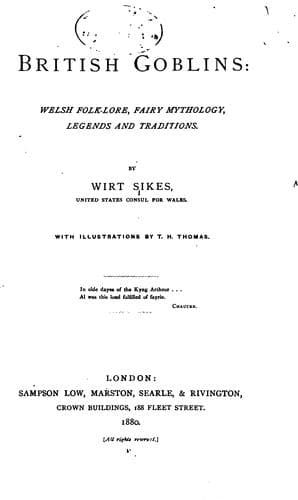
British Goblins: Welsh Folk-lore, Fairy Mythology, Legends and TraditionsSikes, Wirt
History
British Goblins: Welsh Folk-lore, Fairy Mythology, Legends and Traditions
Sikes, Wirt
Folklore -- Wales; Goblins -- Wales; Mythology, Celtic -- Wales; Mythology, Welsh; Wales -- Social life and customs
In the agricultural districts of Wales, the fairies are accredited
with a very complete variety of useful animals; and Welsh folk-lore,
both modern and medieval, abounds with tales regarding cattle, sheep,
horses, poultry, goats, and other features of rural life. Such are the
marvellous mare of Teirnyon, which foaled every first of May, but
whose colt was always spirited away, no man knew whither; the Ychain
Banog, or mighty oxen, which drew the water-monster out of the
enchanted lake, and by their lowing split the rocks in twain; the
lambs of St. Melangell, which at first were hares, and ran frightened
under the fair saint's robes; the fairy cattle which belong to the
Gwraig Annwn; the fairy sheep of Cefn Rhychdir, which rose up out of
the earth and vanished into the sky; even fairy swine, which the
haymakers of Bedwellty beheld flying through the air. To some of these
traditions reference has already been made; others will be mentioned
again. Welsh mountain sheep will run like stags, and bound from crag
to crag like wild goats; and as for Welsh swine, they are more famed
in Cambrian romantic story than almost any other animal that could be
named. Therefore the tale told by Rev. Roger Rogers, of the parish of
Bedwellty, sounds much less absurd in Wales than it might elsewhere.
It relates to a very remarkable and odd sight, seen by Lewis Thomas
Jenkin's two daughters, described as virtuous and good young women,
their father a substantial freeholder; and seen not only by them but
by the man-servant and the maid-servant, and by two of the neighbours,
viz., Elizabeth David, and Edmund Roger. All these six people were on
a certain day making hay in a field called Y Weirglodd Fawr Dafolog,
when they plainly beheld a company of fairies rise up out of the earth
in the shape of a flock of sheep; the same being about a quarter of a
mile distant, over a hill, called Cefn Rhychdir; and soon the fairy
flock went out of sight, as if they vanished in the air. Later in the
day they all saw this company of fairies again, but while to two of
the haymakers the fairies appeared as sheep, to others they appeared
as greyhounds, and to others as swine, and to others as naked infants.
Whereupon the Rev. Roger remarks: 'The sons of infidelity are very
unreasonable not to believe the testimonies of so many witnesses.'[54]
FOOTNOTE:
[54] Jones, 'Apparitions,' 24.
VII.
Public-domain text, read in full here on John Shaqi.
Reviews
Reviews
No reviews yet
Be the first to share your thoughts on this work.
Elsewhere in the archive
Join the Discussion
Join the discussion
Sign in to leave a comment or review.
Sign InorCreate an account