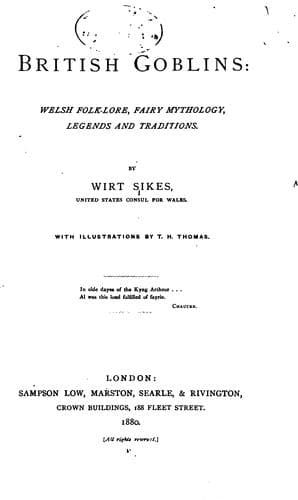
British Goblins: Welsh Folk-lore, Fairy Mythology, Legends and TraditionsSikes, Wirt
History
British Goblins: Welsh Folk-lore, Fairy Mythology, Legends and Traditions
Sikes, Wirt
Folklore -- Wales; Goblins -- Wales; Mythology, Celtic -- Wales; Mythology, Welsh; Wales -- Social life and customs
This observation respecting the mysterious language used by fairies
recalls again the medieval story of Elidurus. The example of fairy
words there given by Giraldus is thought by the learned rector of
Llanarmon[51] to be 'a mixture of Irish and Welsh. The letter U, with
which each of the words begins, is, probably, no more than the
representative of an indistinct sound like the E mute of the French,
and which those whose language and manners are vulgar often prefix to
words indifferently. If, then, they be read dor dorum, and halgein
dorum, dor and halgein are nearly dwr (or, as it is pronounced, door)
and halen, the Welsh words for water and salt respectively. Dorum
therefore is equivalent to "give me," and the Irish expression for
"give me" is thorum; the Welsh dyro i mi. The order of the words,
however, is reversed. The order should be thorum dor, and thorum halen
in Irish, and in Welsh dyro i mi ddwr, and dyro i mi halen, but was,
perhaps, reversed intentionally by the narrator, to make his tale the
more marvellous.'[52]
FOOTNOTES:
[51] Rev. Peter Roberts, 'Cambrian Popular Antiquities,' 195. (1815.)
[52] Supra, p. 67.
V.
The horse plays a very active part in Welsh fairy tales. Not only does
his skeleton serve for Mary Lwyds[53] and the like, but his spirit
flits. The Welsh fairies seem very fond of going horseback. An old
woman in the Vale of Neath told Mrs. Williams, who told Thomas
Keightley, that she had seen fairies to the number of hundreds,
mounted on little white horses, not bigger than dogs, and riding four
abreast. This was about dusk, and the fairy equestrians passed quite
close to her, in fact less than a quarter of a mile away. Another old
woman asserted that her father had often seen the fairies riding in
the air on little white horses; but he never saw them come to the
ground. He heard their music sounding in the air as they galloped by.
There is a tradition among the Glamorgan peasantry of a fairy battle
fought on the mountain between Merthyr and Aberdare, in which the
pigmy combatants were on horseback. There appeared to be two armies,
one of which was mounted on milk-white steeds, and the other on horses
of jet-black. They rode at each other with the utmost fury, and their
swords could be seen flashing in the air like so many penknife blades.
The army on the white horses won the day, and drove the black-mounted
force from the field. The whole scene then disappeared in a light
mist.
FOOTNOTE:
[53] See Index.
VI.
Public-domain text, read in full here on John Shaqi.
Reviews
Reviews
No reviews yet
Be the first to share your thoughts on this work.
Elsewhere in the archive
Join the Discussion
Join the discussion
Sign in to leave a comment or review.
Sign InorCreate an account