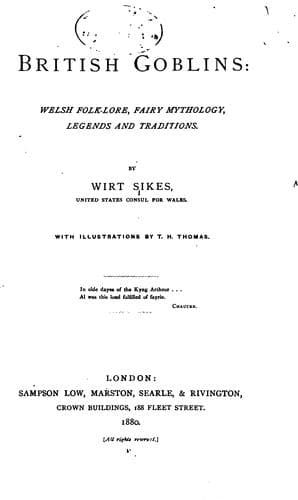
British Goblins: Welsh Folk-lore, Fairy Mythology, Legends and TraditionsSikes, Wirt
History
British Goblins: Welsh Folk-lore, Fairy Mythology, Legends and Traditions
Sikes, Wirt
Folklore -- Wales; Goblins -- Wales; Mythology, Celtic -- Wales; Mythology, Welsh; Wales -- Social life and customs
it under his head. After some time the cock crew at the house of Blaen
y Cwm, hard by, upon which they appeared as if they were surprised and
displeased; the cushion was hastily whisked from under his head, and
the fairies vanished. 'The spirits of darkness do not like the crowing
of the cock, because it gives notice of the approach of day, for they
love darkness rather than light.... And it hath been several times
observed that these fairies cannot endure to hear the name of God.' A
modern Welsh preacher (but one whose opinions contrast most decidedly
with those of Jones) observes: 'The cock is wonderfully well versed in
the circumstances of the children of Adam; his shrill voice at dawn of
day is sufficient intimation to every spirit, coblyn, wraith, elf,
bwci, and apparition to flee into their illusive country for their
lives, before the light of day will show them to be an empty
nothingness, and bring them to shame and reproach.'[55] Shakspeare
introduces this superstition in Hamlet:
_Ber._ It was about to speak, when the cock crew.
_Hor._ And then it started like a guilty thing
Upon a fearful summons.[56]
But the opinion that spirits fly away at cock-crow is of extreme
antiquity. It is mentioned by the Christian poet Prudentius (fourth
century) as a tradition of common belief.[57] As for the effect of the
name of God as an exorcism, we still encounter this superstition, a
living thing in our own day, and in every land where modern
'spiritualism' finds believers. The mischief produced at 'spiritual
seances' by 'bad spirits' is well-known to those who have paid any
attention to this subject. The late Mr. FitzHugh Ludlow once related
to me, with dramatic fervour, the result of his attempts to exorcise a
bad spirit which was in possession of a female 'medium,' by trying to
make her pronounce the name of Christ. She stumbled and stammered over
this test in a most embarrassing way, and finally emerged from her
trance with the holy name unspoken; the bad spirit had fled. This was
in New York, in 1867. Like many others who assert their unbelief in
spiritualism, Mr. Ludlow was intensely impressed by this phenomenon.
Public-domain text, read in full here on John Shaqi.
Reviews
Reviews
No reviews yet
Be the first to share your thoughts on this work.
Elsewhere in the archive
Join the Discussion
Join the discussion
Sign in to leave a comment or review.
Sign InorCreate an account