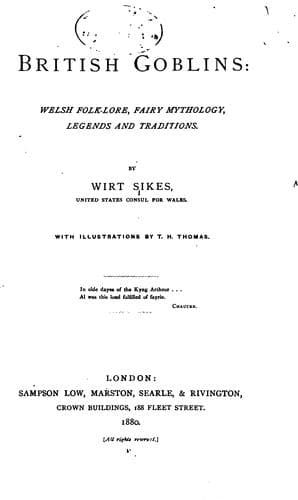
British Goblins: Welsh Folk-lore, Fairy Mythology, Legends and TraditionsSikes, Wirt
History
British Goblins: Welsh Folk-lore, Fairy Mythology, Legends and Traditions
Sikes, Wirt
Folklore -- Wales; Goblins -- Wales; Mythology, Celtic -- Wales; Mythology, Welsh; Wales -- Social life and customs
Students of comparative folk-lore class all such manifestations under
a common head, whether related of fairies or spirit mediums. They
trace their origin to the same source whence come the notions of
propitiating the fairies by euphemistic names. The use of such names
as Jehovah, the Almighty, the Supreme Being, etc., for the terrible
and avenging God of the Jewish theology, being originally an endeavour
to avoid pronouncing the name of God, it is easy to see the connection
with the exorcising power of that name upon all evil spirits, such as
fairies are usually held to be. Here also, it is thought, is presented
the ultimate source of that horror of profane language which prevails
among the Puritanic peoples of England and America. The name of the
devil is similarly provided with euphemisms, some of which--such as
the Old Boy--are not of a sort to offend that personage's ears; and
until recently the word devil was deemed almost as offensive as the
word God, when profanely used.
FOOTNOTES:
[55] Rev. Robert Ellis, in 'Manion Hynafiaethol.' (Treherbert, 1873.)
[56] 'Hamlet,' Act I., Sc. 1.
[57] Brand, 'Popular Antiquities,' ii., 31.
II.
A popular protection from the encroachments of fairies is the eithin,
or prickly furze, common in Wales. It is believed that the fairies
cannot penetrate a fence or hedge composed of this thorny shrub. An
account illustrating this, and otherwise curious in its details, was
given in 1871 by a prominent resident of Anglesea:[58] 'One day, some
thirty years ago, Mrs. Stanley went to one of the old houses to see an
old woman she often visited. It was a wretched hovel; so unusually
dark when she opened the door, that she called to old Betty Griffith,
but getting no answer she entered the room. A little tiny window of
one pane of glass at the further side of the room gave a feeble light.
A few cinders alight in the miserable grate also gave a glimmer of
light, which enabled her to see where the bed used to be, in a recess.
To her surprise she saw it entirely shut out by a barricade of thick
gorse, so closely packed and piled up that no bed was to be seen.
Again she called Betty Griffith; no response came. She looked round
the wretched room; the only symptom of life was a plant of the
Wandering Jew (_Saxifraga tricolor_), so called by the poor people,
and dearly loved to grace their windows. It was planted in a broken
jar or teapot on the window, trailing its long tendrils around, with
here and there a new formed plant seeming to derive sustenance from
the air alone. As she stood, struck with the miserable poverty of the
human abode, a faint sigh came from behind the gorse. She went close
and said, "Betty, where are you?" Betty instantly recognised her
voice, and ventured to turn herself round from the wall. Mrs. Stanley
then made a small opening in the gorse barricade, which sadly pricked
her fingers; she saw Betty in her bed and asked her, "Are you not
well? are you cold, that you are so closed up?" "Cold! no.
Public-domain text, read in full here on John Shaqi.
Reviews
Reviews
No reviews yet
Be the first to share your thoughts on this work.
Elsewhere in the archive
Join the Discussion
Join the discussion
Sign in to leave a comment or review.
Sign InorCreate an account