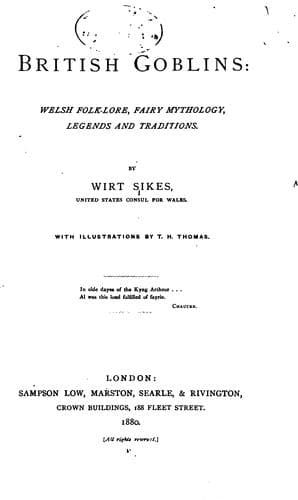
British Goblins: Welsh Folk-lore, Fairy Mythology, Legends and TraditionsSikes, Wirt
History
British Goblins: Welsh Folk-lore, Fairy Mythology, Legends and Traditions
Sikes, Wirt
Folklore -- Wales; Goblins -- Wales; Mythology, Celtic -- Wales; Mythology, Welsh; Wales -- Social life and customs
It is not
cold, Mrs. Stanley; it is the Tylwyth Teg; they never will leave me
alone, there they sit making faces at me, and trying to come to me."
"Indeed! oh how I should like to see them, Betty." "Like to see them,
is it? Oh, don't say so." "Oh but Betty, they must be so pretty and
good." "Good? they are not good." By this time the old woman got
excited, and Mrs. Stanley knew she should hear more from her about the
fairies, so she said, "Well, I will go out; they never will come if I
am here." Old Betty replied sharply, "No, do not go. You must not
leave me. I will tell you all about them. Ah! they come and plague me
sadly. If I am up they will sit upon the table; they turn my milk sour
and spill my tea; then they will not leave me at peace in my bed, but
come all round me and mock at me." "But Betty, tell me what is all
this gorse for? It must have been great trouble for you to make it all
so close." "Is it not to keep them off? They cannot get through this,
it pricks them so bad, and then I get some rest." So she replaced the
gorse and left old Betty Griffith happy in her device for getting rid
of the Tylwyth Teg.'
FOOTNOTE:
[58] Hon. W. O. Stanley, in 'Notes and Queries.'
III.
A common means of getting rid of the fairies is to change one's place
of residence; the fair folk will not abide in a house which passes
into new hands. A story is told of a Merionethshire farmer who, being
tormented beyond endurance by a Bwbach of a mischievous turn,
reluctantly resolved to flit. But first consulting a wise woman at
Dolgelley, he was advised to make a pretended flitting, which would
have the same effect; he need only give out that he was going to move
over the border into England, and then get together his cattle and his
household goods, and set out for a day's drive around the Arenig. The
fairy would surely quit the house when the farmer should quit it, and
especially would it quit the premises of a born Cymro who avowed his
purpose of settling in the foreign land of the Sais. So then he could
come back to his house by another route, and he would find the
obnoxious Bwbach gone. The farmer did as he was told, and set out upon
his journey, driving his cattle and sheep before him, and leading the
cart upon which his furniture was piled, while his wife and children
trudged behind. When he reached Rhyd-y-Fen, a ford so called from this
legend, they met a neighbour, who exclaimed, 'Holo, Dewi, are you
leaving us for good?' Before the farmer could answer there was a
shrill cry from inside the churn on the cart, 'Yes, yes, we are
flitting from Hendrefawr to Eingl-dud, where we've got a new home.' It
was the Bwbach that spoke. He was flitting with the household goods,
and the farmer's little plan to be rid of him was a complete failure.
The good man sighed as he turned his horses about and went back to
Hendrefawr by the same road he had come.
IV.
Public-domain text, read in full here on John Shaqi.
Reviews
Reviews
No reviews yet
Be the first to share your thoughts on this work.
Elsewhere in the archive
Join the Discussion
Join the discussion
Sign in to leave a comment or review.
Sign InorCreate an account