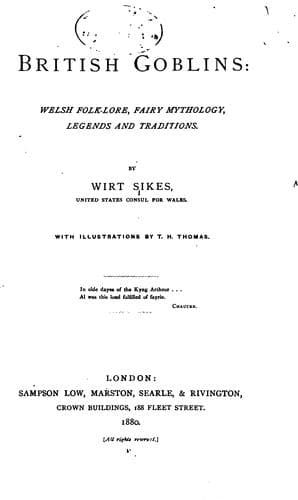
British Goblins: Welsh Folk-lore, Fairy Mythology, Legends and TraditionsSikes, Wirt
History
British Goblins: Welsh Folk-lore, Fairy Mythology, Legends and Traditions
Sikes, Wirt
Folklore -- Wales; Goblins -- Wales; Mythology, Celtic -- Wales; Mythology, Welsh; Wales -- Social life and customs
A Pembrokeshire Welshman told me this story as a tradition well known
in that part of Wales. Ianto Llewellyn was a man who lived in the
parish of Llanfihangel, not more than fifty or eighty years ago, and
who had precious good reason to believe in the fairies. He used to
keep his fire of coal balls burning all night long, out of pure
kindness of heart, in case the Tylwyth Teg should be cold. That they
came into his kitchen every night he was well aware; he often heard
them. One night when they were there as usual, Ianto was lying wide
awake and heard them say, 'I wish we had some good bread and cheese
this cold night, but the poor man has only a morsel left; and though
it's true that would be a good meal for us, it is but a mouthful to
him, and he might starve if we took it.' At this Ianto cried out at
the top of his voice, 'Take anything I've got in my cupboard and
welcome to you!' Then he turned over and went to sleep. The next
morning, when he descended into the kitchen, he looked in his
cupboard, to see if by good luck there might be a bit of crust there.
He had no sooner opened the cupboard door than he cried out, 'O'r
anwyl! what's this?' for there stood the finest cheese he had ever
seen in his life, with two loaves of bread on top of it. 'Lwc dda i
ti!' cried Ianto, waving his hand toward the wood where he knew the
fairies lived; 'good luck to you! May you never be hungry or
penniless!' And he had not got the words out of his mouth when he
saw--what do you think?--a shilling on the hob! But that was the lucky
shilling. Every morning after this, when Ianto got up, there was the
shilling on the hob--another one, you mind, for he'd spent the first
for beer and tobacco to go with his bread and cheese. Well, after
that, no man in the parish was better supplied with money than Ianto
Llewellyn, though he never did a stroke of work. He had enough to keep
his wife in ease and comfort, too, and he got the name of Lucky Ianto.
And lucky he might have been to the day of his death but for the
curiosity of woman. Betsi his wife was determined to know where all
this money came from, and gave the poor man no peace. 'Wel, naw wfft!'
she cried--which means in English, 'Nine shames on you'--'to have a
bad secret from your own dear wife!' 'But you know, Betsi, if I tell
you I'll never get any more money.' 'Ah,' said she, 'then it's the
fairies!' 'Drato!' said he--and that means 'Bother it all'--'yes--the
fairies it is.' With that he thrust his hands down in his breeches
pockets in a sullen manner and left the house. He had had seven
shillings in his pockets up to that minute, and he went feeling for
them with his fingers, and found they were gone. In place of them were
some pieces of paper fit only to light his pipe. And from that day the
fairies brought him no more money.
V.
Public-domain text, read in full here on John Shaqi.
Reviews
Reviews
No reviews yet
Be the first to share your thoughts on this work.
Elsewhere in the archive
Join the Discussion
Join the discussion
Sign in to leave a comment or review.
Sign InorCreate an account