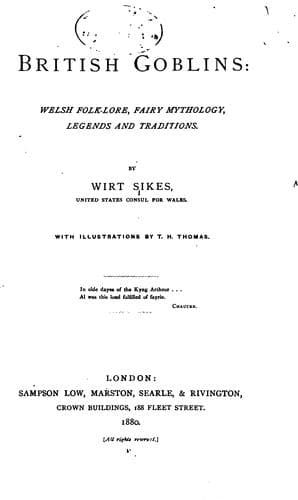
British Goblins: Welsh Folk-lore, Fairy Mythology, Legends and TraditionsSikes, Wirt
History
British Goblins: Welsh Folk-lore, Fairy Mythology, Legends and Traditions
Sikes, Wirt
Folklore -- Wales; Goblins -- Wales; Mythology, Celtic -- Wales; Mythology, Welsh; Wales -- Social life and customs
The lesson of generosity is taught with force and simplicity in the
legend of Hafod Lwyddog, and the necessity for secrecy is quite
abandoned. Again it is a shepherd, who dwelt at Cwm Dyli, and who went
every summer to live in a cabin by the Green Lake (Llyn Glas) along
with his fold. One morning on awaking from sleep he saw a good-looking
damsel dressing an infant close by his side. She had very little in
which to wrap the babe, so he threw her an old shirt of his own, and
bade her place it about the child. She thanked him and departed. Every
night thereafter the shepherd found a piece of silver placed in an
old clog in his cabin. Years and years this good luck continued, and
Meirig the shepherd became immensely wealthy. He married a lovely
girl, and went to the Hafod Lwyddog to live. Whatever he undertook
prospered--hence the name Hafod Lwyddog, for Lwydd means prosperity.
The fairies paid nightly visits to the Hafod. No witch or evil sprite
could harm this people, as Bendith y Mamau was poured down upon the
family, and all their descendants.[60]
FOOTNOTE:
[60] 'Cymru Fu,' 472.
VI.
The thought will naturally occur that by fostering belief in such
tales as some of the foregoing, roguery might make the superstition
useful in silencing inquiry as to ill-gotten gains. But on the other
hand the virtues of hospitality and generosity were no doubt fostered
by the same influences. If any one was favoured by the fairies in this
manner, the immediate explanation was, that he had done a good turn to
them, generally without suspecting who they were. The virtues of
neatness, in young girls and servants, were encouraged by the like
notions; the belief that a fairy will leave money only on a clean-kept
hob, could tend to nothing more directly. It was also made a condition
of pleasing the Tylwyth Teg that the hearth should be carefully swept
and the pails left full of water. Then the fairies would come at
midnight, continue their revels till daybreak, sing the well-known
strain of 'Toriad y Dydd,' or 'The Dawn,' leave a piece of money on
the hob, and disappear. Here is seen a precaution against fire in the
clean-swept hearth and the provision of filled water-pails. That the
promised reward did not always arrive, was not evidence it would never
arrive; and so the virtue of perseverance was also fostered.
Superstitions of this class are widely prevalent among Aryan peoples.
The 'Arabian Nights' story of the old rogue whose money turned to
leaves will be recalled. In Danish folk-lore, the fairy money bestowed
on the boors turns sometimes to pebbles, and sometimes grows hot and
burns their fingers, so that they drop it, when it sinks into the
earth.
[Music: TORIAD Y DYDD.]
CHAPTER XI.
Public-domain text, read in full here on John Shaqi.
Reviews
Reviews
No reviews yet
Be the first to share your thoughts on this work.
Elsewhere in the archive
Join the Discussion
Join the discussion
Sign in to leave a comment or review.
Sign InorCreate an account