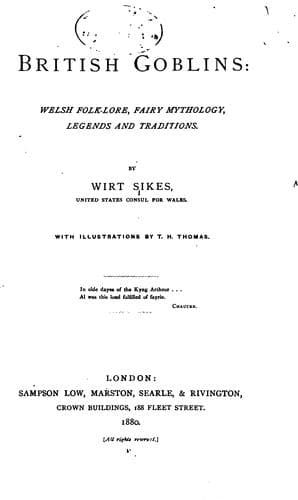
British Goblins: Welsh Folk-lore, Fairy Mythology, Legends and TraditionsSikes, Wirt
History
British Goblins: Welsh Folk-lore, Fairy Mythology, Legends and Traditions
Sikes, Wirt
Folklore -- Wales; Goblins -- Wales; Mythology, Celtic -- Wales; Mythology, Welsh; Wales -- Social life and customs
The Prophet Jones, in explaining why the fairies have been so active
in Wales, expounds the poetico-religious theory in masterly form.
After stating that some in Monmouthshire were so ignorant as to think
the fairies happy spirits, because they had music and dancing among
them, he proceeds to assert, in the most emphatic terms, that the
Tylwyth Teg are nothing else, 'after all the talking about them,' but
the disembodied spirits of men who lived and died without the
enjoyment of the means of grace and salvation, as Pagans and others,
and whose punishment therefore is far less severe than that of those
who have enjoyed the means of salvation. 'But some persons may desire
to know why these fairies have appeared in Wales more than in some
other countries? to which I answer, that I can give no other reason
but this, that having lost the light of the true religion in the
eighth and ninth centuries of Christianity, and received Popery in its
stead, it became dark night upon them; and then these spirits of
darkness became more bold and intruding; and the people, as I said
before, in their great ignorance seeing them like a company of
children in dry clean places, dancing and having music among them,
thought them to be some happy beings, ... and made them welcome in
their houses.... The Welsh entered into familiarity with the fairies
in the time of Henry IV., and the evil then increased; the severe laws
of that prince enjoining, among other things, that they were not to
bring up their children to learning, etc., by which a total darkness
came upon them; which cruel laws were occasioned by the rebellion of
Owen Glandwr, and the Welsh which joined with him; foolishly thinking
to shake off the Saxon yoke before they had repented of their sins.'
Whatever their locally accepted causes of being may be, it is beyond
any question that in the fairy folk-lore of Wales, as of other lands,
are to be found the _débris_ of ancient mythology--scintillant
fragments of those magic constellations which glow in the darkness of
primeval time, grand and majestic as the vast Unknown out of which
they were evolved by barbaric fancy. Through the aid of modern
scientific research, 'those ages which the myths of centuries have
peopled with heroic shadows'[63] are brought nearer to us, and the
humble Welsh Tylwyth Teg may reach back and shake hands with the
Olympian gods.
[Illustration: "THE HUMBLE 'TYLWYTH TEG' SHAKE HANDS WITH THE
OLYMPIAN GODS."]
FOOTNOTE:
[63] Marquis of Bute, address before the Royal Archæological
Institute, Cardiff meeting.
BOOK II.
THE SPIRIT-WORLD.
Where the wan spectres walk eternal rounds.
POPE.
_Miranda._ What is't? a spirit?
Lord, how it looks about! Believe me, sir,
It carries a brave form:--But 'tis a spirit.
SHAKSPEARE: _Tempest_.
CHAPTER I.
Public-domain text, read in full here on John Shaqi.
Reviews
Reviews
No reviews yet
Be the first to share your thoughts on this work.
Elsewhere in the archive
Join the Discussion
Join the discussion
Sign in to leave a comment or review.
Sign InorCreate an account