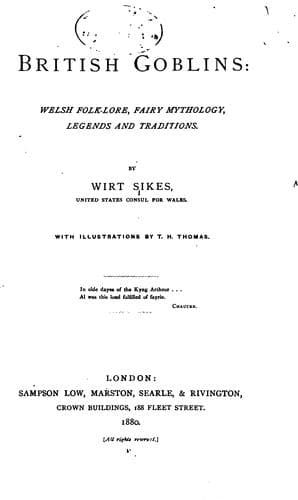
British Goblins: Welsh Folk-lore, Fairy Mythology, Legends and TraditionsSikes, Wirt
History
British Goblins: Welsh Folk-lore, Fairy Mythology, Legends and Traditions
Sikes, Wirt
Folklore -- Wales; Goblins -- Wales; Mythology, Celtic -- Wales; Mythology, Welsh; Wales -- Social life and customs
Welsh peasantry, coarsely and darkly clad themselves, would make white
a purely holiday colour, and devise some other hue for such commoner
fairies as the Bwbach and his sort:
The coarse and country fairy,
That doth haunt the hearth and dairy.[61]
So the Bwbach is usually brown, often hairy; and the Coblynau are
black or copper-coloured in face as well as dress.
FOOTNOTE:
[61] Jonson, Masque of 'Oberon.'
V.
A local legend of the origin of fairies in Anglesea mingles the
practical and the spiritual in this manner: 'In our Saviour's time
there lived a woman whose fortune it was to be possessed of nearly a
score of children, ... and as she saw our blessed Lord approach her
dwelling, being ashamed of being so prolific, and that He might not
see them all, she concealed about half of them closely, and after his
departure, when she went in search of them, to her great surprise
found they were all gone. They never afterwards could be discovered,
for it was supposed that as a punishment from heaven for hiding what
God had given her, she was deprived of them; and it is said these her
offspring have generated the race called fairies.'[62]
FOOTNOTE:
[62] 'Camb. Sup.,' 118.
VI.
The common or popular theory, however, is in Wales the
poetico-religious one. This is, in a word, the belief that the Tylwyth
Teg are the souls of dead mortals not bad enough for hell nor good
enough for heaven. They are doomed to live on earth, to dwell in
secret places, until the resurrection day, when they will be admitted
into paradise. Meantime they must be either incessantly toiling or
incessantly playing, but their toil is fruitless and their pleasure
unsatisfying. A variation of this general belief holds these souls to
be the souls of the ancient Druids, a fancy which is specially
impressive, as indicating the duration of their penance, and reminds
us of the Wandering Jew myth. It is confined mainly to the Coblynau,
or dwellers in mines and caves. Another variation considers the
fairies bad spirits of still remoter origin--the same in fact who were
thrown over the battlements of heaven along with Satan, but did not
fall into hell--landed on the earth instead, where they are permitted
to tarry till doomsday as above. A detail of this theory is in
explanation of the rare appearance of fairies nowadays; they are
refraining from mischief in view of the near approach of the judgment,
with the hope of thus conciliating heaven.
Public-domain text, read in full here on John Shaqi.
Reviews
Reviews
No reviews yet
Be the first to share your thoughts on this work.
Elsewhere in the archive
Join the Discussion
Join the discussion
Sign in to leave a comment or review.
Sign InorCreate an account