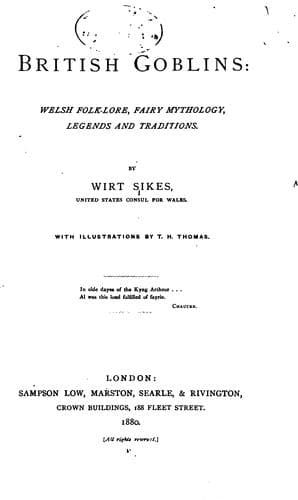
British Goblins: Welsh Folk-lore, Fairy Mythology, Legends and TraditionsSikes, Wirt
History
British Goblins: Welsh Folk-lore, Fairy Mythology, Legends and Traditions
Sikes, Wirt
Folklore -- Wales; Goblins -- Wales; Mythology, Celtic -- Wales; Mythology, Welsh; Wales -- Social life and customs
That this age is superstitious with regard to ghosts, is not
wonderful; all ages have been so; the wonder is that this age should
be so and yet be the possessor of a scientific record so extraordinary
as its own. An age which has brought forth the magnetic telegraph,
steamships and railway engines, sewing-machines, mowing-machines,
gas-light, and innumerable discoveries and inventions of marvellous
utility--not to allude to those of our own decade--should have no
other use for ghostology than a scientific one. But it would be a work
as idle as that of the Coblynau themselves, to point out how universal
among the most civilised nations is the superstition that spirits
walk. The 'controls' of the modern spiritualistic seance have the
world for their audience. The United States, a land generally
deemed--at least by its inhabitants--to be the most advanced in these
directions of any on God's footstool, gave birth to modern
spiritualism. Its disciples there compose a vast body of people,
respectable and worthy people in the main (as the victims of
superstition usually are), among whom are many men of high
intellectual ability. With the masses, some degree of belief in the
spirits is so nearly universal that I need hardly qualify the
adjective. In a country where there is practically no such class as
that represented in Europe by the peasantry, the rampancy of such a
belief is a phenomenon deserving close and curious study. The present
work affords no scope for this study, of course. But I may here
mention in further illustration of my immediate theme, the constant
appearance, in American communities, of ghosts of the old-fashioned
sort. Especially in the New England states, which are notable for
their enlightenment, are ghost-stories still frequent--such as that of
the haunted school-house at Newburyport, Mass., where a disembodied
spirit related its own murder; of the ghost of New Bedford, which
struck a visitor in the face, so that he yet bears the marks of the
blow; of the haunted house at Cambridge, in the classic shadow of
Harvard College. It is actually on record in the last-named case, that
the house fell to decay on account of its ghastly reputation, as no
one would live in it; that a tenant who ventured to occupy it in 1877
was disturbed by the spirit of a murdered girl who said her mortal
bones were buried in his cellar; and that a party of men actually dug
all night in that cellar in search of those bones, while the ghost
waltzed in a chamber overhead. The more common form of spirit peculiar
to our time appears constantly in various parts of the country; it is
continually turning up in the American newspapers, rapping on walls,
throwing stones, tipping over tables, etc. 'Mediums' of every grade
of shrewdness and stupidity, and widely differing degrees of education
and ignorance, flourish abundantly. Occasionally, where revelations of
murder have been made to a mortal by a spirit, the police have taken
the matter in hand.
Public-domain text, read in full here on John Shaqi.
Reviews
Reviews
No reviews yet
Be the first to share your thoughts on this work.
Elsewhere in the archive
Join the Discussion
Join the discussion
Sign in to leave a comment or review.
Sign InorCreate an account