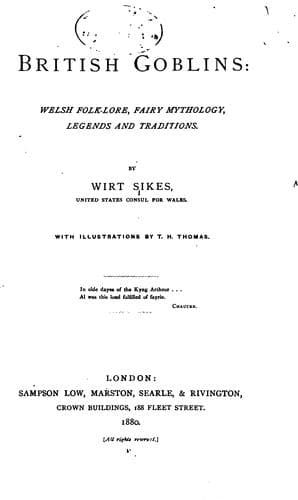
British Goblins: Welsh Folk-lore, Fairy Mythology, Legends and TraditionsSikes, Wirt
History
British Goblins: Welsh Folk-lore, Fairy Mythology, Legends and Traditions
Sikes, Wirt
Folklore -- Wales; Goblins -- Wales; Mythology, Celtic -- Wales; Mythology, Welsh; Wales -- Social life and customs
It is to be observed as a commendable practice in
such cases, that the mortal is promptly arrested by the police if
there has really been a murder; and when the fact appears, as it
sometimes does, that the mortal had need of no ghost to tell him what
he knows, he is hanged.
II.
The Welsh dearly love to discuss questions of a spiritual and
religious nature, and there are no doubt many who look upon disbelief
herein as something approaching paganism. That one should believe in
God and a future life, and yet be utterly incredulous as to the
existence of a mundane spirit-world, seems to such minds impossible.
It is not many years since the clergy taught a creed of this sort. One
must not only believe in a spiritual existence, but must believe in
that existence here below--must believe that ghosts walked, and
meddled, and made disagreeable noises. Our friend the Prophet Jones
taught this creed with energy. In his relation of apparitions in
Monmouthshire, he says: 'Enough is said in these relations to satisfy
any reasonable sober-minded person, and to confute this ancient
heresy, now much revived and spreading, especially among the gentry,
and persons much estranged from God and spiritual things; and such as
will not be satisfied with things plainly proved and well designed;
are, in this respect, no better than fools, and to be despised as
such.... They are chiefly women and men of weak and womanish
understandings, who speak against the accounts of spirits and
apparitions. In some women this comes from a certain proud fineness,
excessive delicacy, and a superfine disposition which cannot bear to
be disturbed with what is strange and disagreeable to a vain spirit.'
Nor does the Prophet hesitate to apply the term 'Sadducees' to all
doubters of his goblins. His warrant for this is found in Wesley and
Luther. That Luther saw apparitions, or believed he did, is commonly
known. Wesley's beliefs in this direction, however, are of a nearer
century, and strike us more strangely; though it must be said that the
Prophet Jones, in our own century, believed more than either of his
eminent prototypes. 'It is true,' wrote Wesley, 'that the English in
general, and indeed most of the men in Europe, have given up all
accounts of witches and apparitions as mere old wives' fables. I am
sorry for it, and I willingly take this opportunity of entering my
solemn protest against this violent compliment which so many that
believe the Bible pay to those who do _not_ believe it.... They well
know, whether Christians know it or not, that the giving up witchcraft
is, in effect, giving up the Bible. And they know, on the other hand,
that if but one account of the intercourse of men with separate
spirits be admitted, their whole castle in the air--deism, atheism,
materialism--falls to the ground.'
III.
Public-domain text, read in full here on John Shaqi.
Reviews
Reviews
No reviews yet
Be the first to share your thoughts on this work.
Elsewhere in the archive
Join the Discussion
Join the discussion
Sign in to leave a comment or review.
Sign InorCreate an account