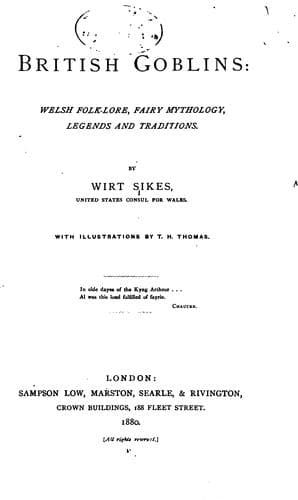
British Goblins: Welsh Folk-lore, Fairy Mythology, Legends and TraditionsSikes, Wirt
History
British Goblins: Welsh Folk-lore, Fairy Mythology, Legends and Traditions
Sikes, Wirt
Folklore -- Wales; Goblins -- Wales; Mythology, Celtic -- Wales; Mythology, Welsh; Wales -- Social life and customs
... the place is haunted!
would not recall the smug tidiness of Duffryn House, whose clean-cut
lawns and well-trimmed hedges are fit surroundings of a mansion where
luxurious comfort reigns. A ghost which confines itself to the cellar
and the garden need disturb neither the merrymaking nor the slumbers
of the guests.
St. Donat's Castle is down on the southern coast of Glamorganshire, in
a primitive region not yet profaned by railroads, nor likely to be
perhaps for many years to come. It is owned and inhabited by a worthy
gentleman whose ancestors for seven centuries sleep in the graveyard
under the old castle wall. Its favourite ghost--for to confine this
or any other ancient Welsh castle to a single ghost would be almost
disrespectful--is that of Lady Stradling, who was done away with by
some of her family in those wicked old times when families did not
always dwell in peace together. This ghost makes a practice of
appearing when any mishap is about to befall a member of the house of
Stradling--the direct line of which is, however, extinct, a fact not
very well apprehended among the neighbouring peasantry. She wears
high-heeled shoes and a long trailing gown of the finest silk. In this
guise doth she wander up and down the long majestic halls and
chambers, and, while she wanders, the castle hounds refuse to rest,
but with their howlings raise all the dogs of the village under the
hill.
V.
Ghosts of this sort are vague and purposeless in character, beyond a
general blood-curdling office which in all ghosts doth dwell. They
haunt not only castles and family mansions, but bridges, rocks, and
roads, objectless but frightful. The ghost of Pont Cwnca Bach, near
Yscanhir, in Carmarthenshire, frightens people off the bridge into the
rivulet. Many belated peasants have had this dire experience at the
little bridge, afterwards wandering away in a dazed condition, and
finding themselves on recovering at some distance from home, often in
the middle of a bog. In crossing this bridge people were seized with
'a kind of _cold dread_,' and felt 'a peculiar sensation' which they
could not describe, but which the poorest fancy can no doubt imagine.
Another purposeless spectre exists in the legend of Catrin Gwyn, told
in Cardiganshire. The ruin of a shepherd's cottage, standing on a
mountain waste near the river Rheidol, is the haunt of this spectre.
A peasant who was asked to escort a stranger up the narrow defile of
rocks by the ruin, in horror exclaimed, 'Yn enw y daioni, peidiwch,'
(in the name of heaven, sir, don't go!) 'or you'll meet White Catti of
the Grove Cave.' 'And what's that?' 'An evil spirit, sir.' And the
superstitious peasant would neither be laughed nor reasoned out of his
fears. Catrin was the bride of a young shepherd living near
Machynlleth in 1705. One day she went to market with a party of other
peasants, who separated from her on the return way at a point two
miles from Gelli Gogo. She was never more seen alive. A violent storm
Public-domain text, read in full here on John Shaqi.
Reviews
Reviews
No reviews yet
Be the first to share your thoughts on this work.
Elsewhere in the archive
Join the Discussion
Join the discussion
Sign in to leave a comment or review.
Sign InorCreate an account